Brush Clearing in Clarksville, TN
Overgrown ground taken back to a workable surface, quoted in the density class it falls in rather than at one flat figure per acre.
Get a Free Land Clearing Quote in Clarksville
Tell us the acreage, the road it fronts and what the ground has to do afterwards. Form requests are answered the same working day, and every quote follows a site walk.
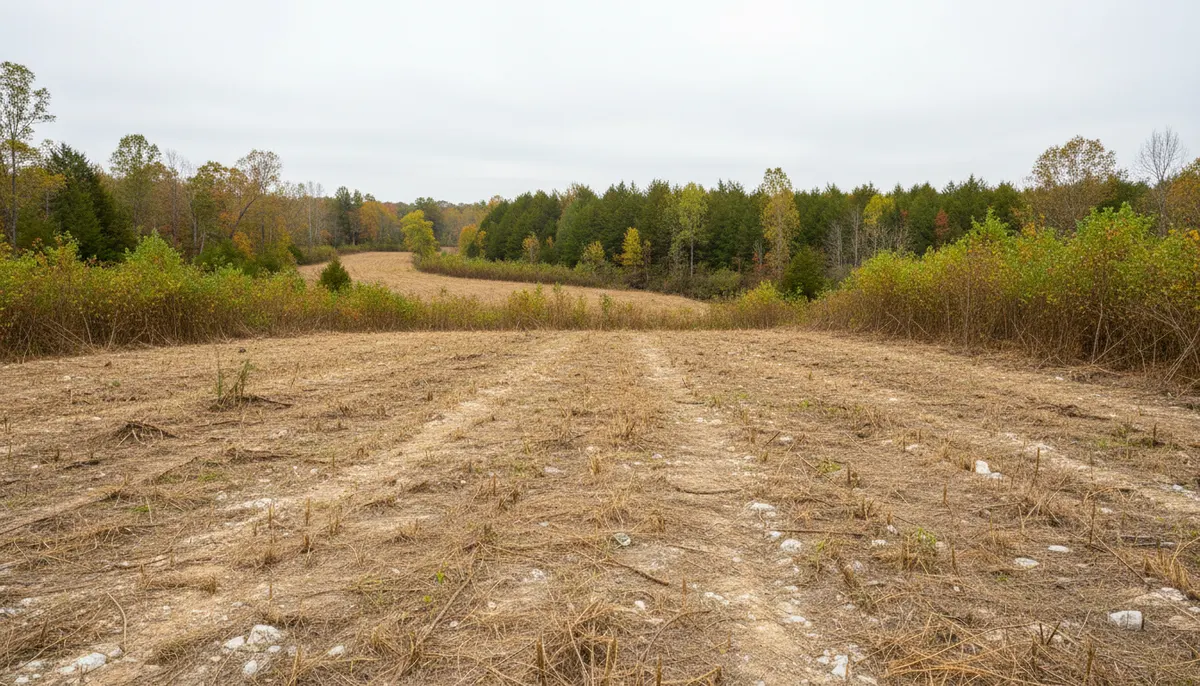
Brush clearing services in Clarksville, TN are priced by density class, and which class your ground sits in tells you more about the bill than the acreage does. Light brush and grass, medium brush with small trees, and heavy stands are the three bands, and the same acre can fall in any of them depending on how many seasons it has been left alone.
Ground closes in quickly. Zone 7a and 7b with 50.99 inches of rain a year is a growing environment, not a holding one. Briar, honeysuckle and volunteer stems come first, and once stems pass a few inches the job stops being brush work. Where standing timber is mixed through it, a machine that can take stems is the honest answer.
Where Brush Work Gets Bought
Four recurring situations.
Fields that stopped being cut
Two or three seasons without maintenance puts a briar and sapling mat over ground that used to be hay. Cutting it back is easy; keeping it back is a maintenance decision.
Boundaries, fence runs and ditch lines
Linear work quoted by length and working width rather than by the acre.
Understory beneath a canopy worth keeping
The tangle underneath is the problem and the mature stems are the asset. Taking one without the other costs more per unit, and it is still right on a homesite.
Density Classes, and the Machines Behind Each
The class is the pricing language of the trade, and it maps to equipment.
Light: grass, weeds and thin cover
A tractor-mounted rotary cutter handles it at speed. Rotary cutting is maintenance rather than clearing and does nothing to woody stems above a couple of inches, which is why it is cheap.
Medium: closed brush with saplings through it
Where a mulching head on a compact track loader earns its place: tracks spread machine weight and keep ground pressure low enough to work soft spring ground without rutting it.
Heavy: stems you would call trees
Stems over 6 inches in diameter add 15 to 30 percent on that factor alone. Head makers publish a horsepower rule rather than a diameter rating: 70 or more horsepower for moderate brush and small trees, 100 or more for heavy-duty work.
The Order a Brush Job Runs In
-
Classify the ground and mark the exclusions
We walk it, put it in a density class, and flag what does not get cut: kept stems, a septic lid, a well head, a wet corner, a creek.
-
Notify 811 and check the acreage trigger
Tennessee 811 needs three working days of notice and the marks hold 15 calendar days. Brush work at ground level still reaches shallow services.
-
Cut to the class, edges first
The perimeter goes first so the operator has a visible line to work to, then the interior on overlapping passes. Hand work covers fences, posts and structures.
-
Handle the material and set the follow-up
Cut brush is mulched, chipped, hauled or piled, priced up front. Before we leave, the regrowth conversation happens.
Why Cut Brush Comes Back, and What Genuinely Stops It
Cutting removes the top, and the top is not the plant
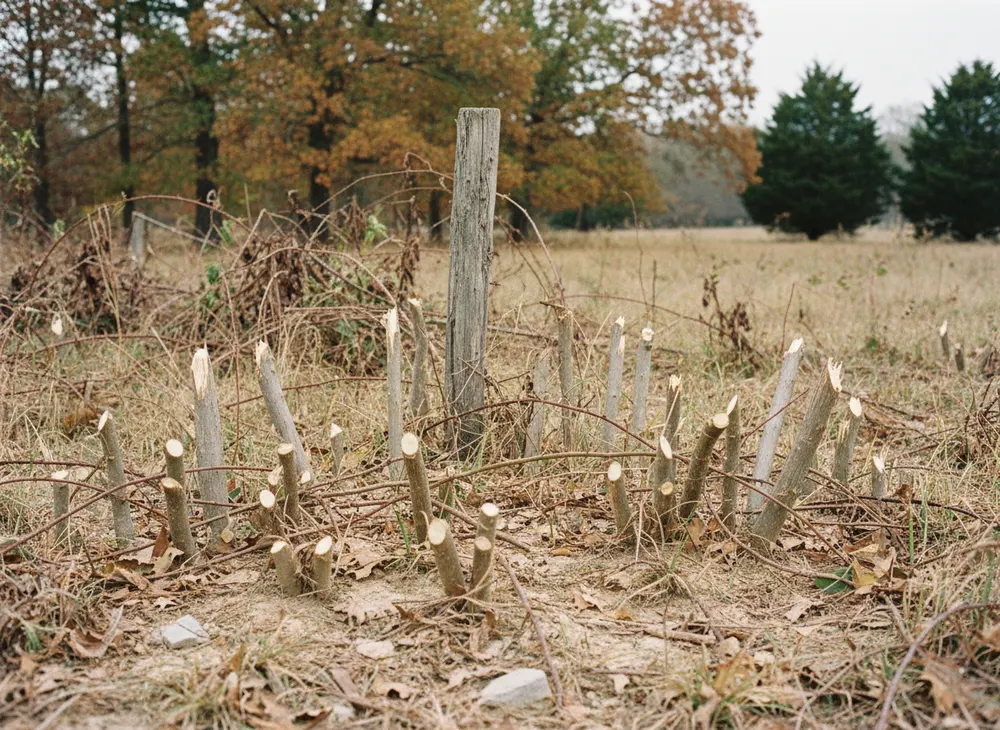
Oak and hickory make up 69.7 percent of Tennessee forest land, and hardwood is a sprouting forest type. When a stem is cut at the soil surface, the root collar and root system stay alive with a full stored energy supply and no top to support. Oak, hickory, red maple and sweetgum answer by pushing several sprouts from the collar, so one cut stem returns as a cluster and the stand comes back denser. Anyone promising a single pass ends it is selling you a second pass. Two things change the outcome. A cutting cycle drains the reserves by removing regrowth while it is soft, which on pasture ground is the cheapest control available. Removing the root mass outright is the other: grubbing rather than cutting, in the $2,600 to $4,160 per acre Tennessee band, creating the most exposed soil of any scope, so stabilisation falls due within two weeks of activity ceasing in that portion and one week on steep slopes.
Brush on a creek bank has a measured limit
Plenty of overgrown ground here has water down the low side, and that changes the scope before the machine starts. Under the Tennessee construction general permit a 30-foot natural water quality riparian buffer is preserved between the waterbody and the disturbed area to the maximum extent practicable, with a minimum width of more than 15 feet at any measured location. The last 30 feet before the water is buffer, not cutting zone. Cutting to the water line costs the buffer, puts sediment in the stream on the next rainfall, and on a permitted site is a documented violation.
Brush Clearing Prices Around Clarksville
Brush removal: $800 to $3,000 per acre, up to $5,000 where trees are involved
The headline is the national brush removal range. Per-acre bands are Tennessee density-class figures from a published 2026 state cost guide.
| Scope | Typical range | What it covers |
|---|---|---|
| Light brush and grass | $975 to $1,560 per acre | Thin cover, nothing woody worth the name. 3 to 5 hours per acre. |
| Medium brush with small trees | $1,430 to $2,210 per acre | The default after two or three seasons untouched. 5 to 8 hours per acre. |
| Heavy stand with large stems | $2,080 to $3,250 per acre | 8 to 10 or more hours per acre. The stems are their own disposal question. |
| Hand labour and on-site chipping | $50 to $80 per hour of labour, $100 to $150 per hour of chipping | What edges and structures cost, plus the machine that turns brush into cover. |
What moves the price
- Density class, worth a three to eight times spread by itself.
- Stem size, where numerous stems over 6 inches in diameter add 15 to 30 percent.
- Slope, worth 20 to 30 percent on moderate ground and 40 to 60 percent where it is steep or rocky.
Three acres of medium brush on gentle ground with gate access. At the Tennessee medium band that is $4,290 to $6,630 for the cutting, and three acres sits below the five-acre point where a 10 to 25 percent volume discount appears. Disturbance is over an acre, so the county grading permit at $65 per acre and plan review at $50 per acre come to $345 plus the $10 archives fee, and state stormwater coverage is $250.
What You Get From Us on a Brush Job
The class is stated, not implied
You are told which density band your ground is in and why, before the quote goes out.
Buffers and exclusions get staked
Creeks, wet ground, kept stems and service lines are marked with you before cutting. Judging a 30-foot buffer from a moving machine is how sites fall out of compliance.
Common Questions About Overgrown Ground
How do I keep the underbrush from growing back?
With a cutting cycle or by removing the roots. Cutting takes the top off a plant whose root system is intact and full of reserves, so oak, hickory, red maple and sweetgum sprout hard from a cut collar. Grubbing removes the root mass outright at $2,600 to $4,160 per acre.
What happens to all the cut material?
Mulching in place leaves it as cover and removes the disposal line. On-site chipping runs $100 to $150 per hour. Hauling is $150 to $200 per pickup load or $150 to $350 per yard-waste load. More on choosing between the disposal routes.
Do I need a permit to clear brush?
The trigger is soil disturbed, not vegetation type. One or more acres requires coverage under Tennessee permit TNR100000, applied for 30 days ahead with a site-specific stormwater pollution prevention plan. Montgomery County adds grading, drainage and erosion control plans above the same line under Resolution #13-2-2.
Will brush clearing damage my fence or septic field?
Not if they are marked. Fence lines get a stated working width and hand work at the posts. Septic lids and shallow runs are exclusion zones, and the 811 tolerance zone of 24 inches each side of a marked facility is hand area. Travel routes go around a working drain field, since compaction is a real risk.
Where Brush Work Usually Leads Next
Rotary cutting on a maintenance cycle keeps ground open once the heavy work is done, and stops a field closing back in.
Taking the root mass out for good is the step up wherever regrowth is unacceptable or a footing or septic field is going in.
Opening a whole parcel rather than a patch is the broader scope when brush is only part of what is standing.
Clearing downed timber after weather is a different problem, since hangers and broken stems hold stored tension.
Book a Site Walk on Your Acreage
Send the parcel details and we will walk the ground, measure the disturbed area, check the stormwater threshold and put a written scope in front of you before any machine is booked.