Land Clearing for Home Building in Clarksville, TN
A grubbed building envelope, topsoil stockpiled rather than lost, compacted subgrade and an access route that will carry a loaded concrete truck.
Get a Free Land Clearing Quote in Clarksville
Tell us the acreage, the road it fronts and what the ground has to do afterwards. Form requests are answered the same working day, and every quote follows a site walk.
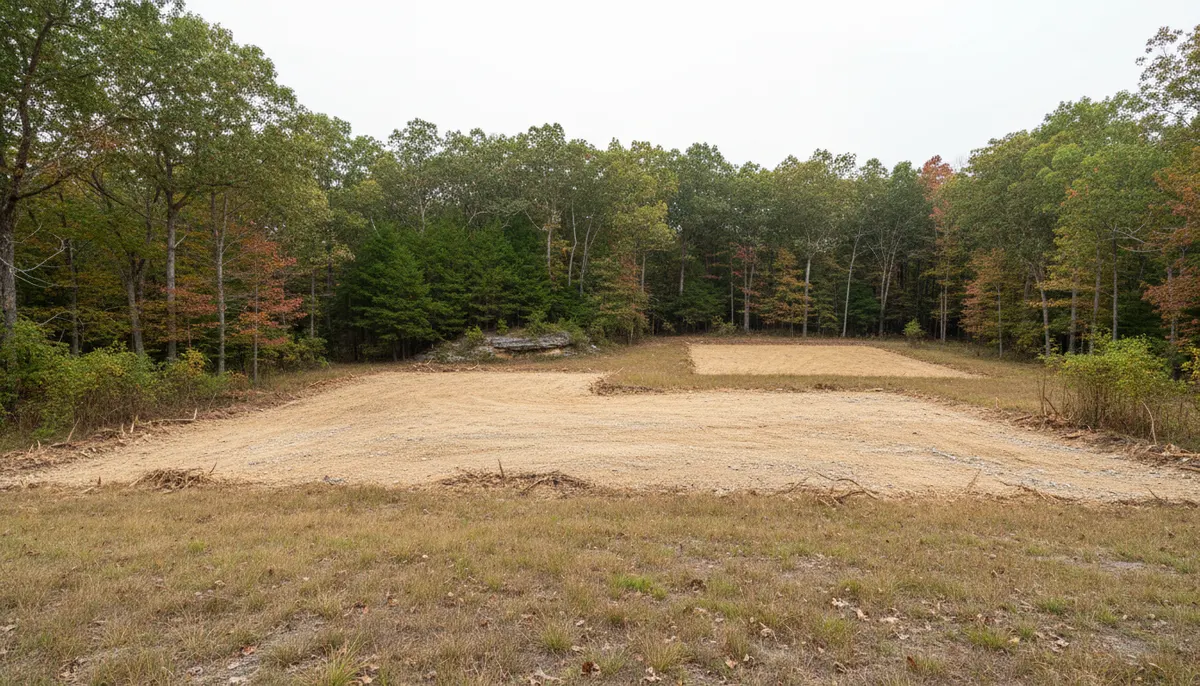
Land clearing for home building in Clarksville, TN is not the same job as opening up a view, and the difference costs money in the wrong order if it is discovered late. A builder needs four things off a wooded lot: a grubbed envelope with the roots gone, topsoil stripped and stockpiled instead of buried, subgrade that compacts, and a drive a loaded concrete truck can reach the pad on. Everything else is preference.
Most active new-build ground here sits on the rural fringe, in corridors like Sango and Rossview, on tracts never subdivided in the usual sense. That shapes the two questions worth answering before anything is cleared: where the house physically sits, and whether the ground under the septic area will take it. Neither is something a mulching pass can answer.
The Four Pieces of a Buildable Homesite
What a builder needs handed over, priced as separate items.
The grubbed building envelope
Stems, stumps and root mat out where footings, slab and garage go, taken wider than the structure because settlement travels outward.
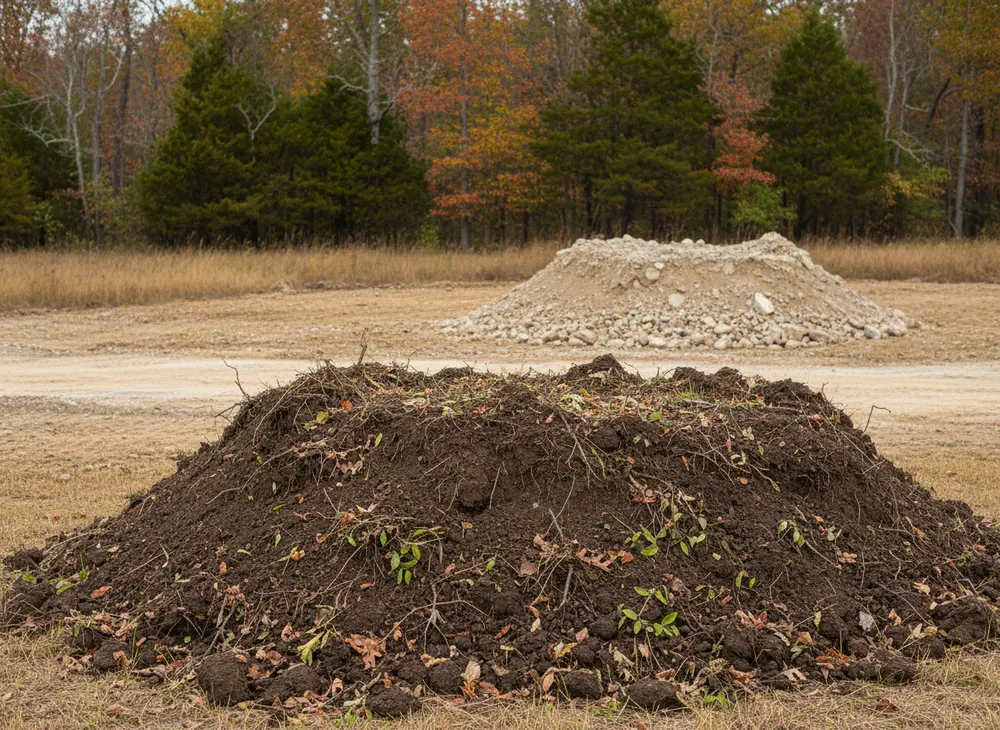
Topsoil stripped and stockpiled
Stockpiled inside the limit of disturbance rather than buried under fill. Buying it back later is a pure loss.
Driveway and turning access
A ready-mix truck is the heaviest vehicle that will ever visit, and it arrives before the drive is finished.
Septic area kept clear and uncompacted
Cleared but not trafficked. Running plant across it destroys the soil structure the system depends on.
What a Wooded Lot Here Is Made Of
Three things that decide how a homesite clears, none visible from the road.
Oak and hickory canopy
Oak and hickory make up 69.7 percent of Tennessee forest land, 83 percent of it privately owned. Yellow-poplar is 11.6 percent of state volume, white oak 9.2, chestnut oak 8.2. Large hardwood is slow to remove and makes real haul volume.
Fragipan and perched water
Dickson-series soils carry a dense restrictive layer that perches water above it. It affects where a house sits and how a drainfield performs.
Karst below
A sinkhole plain over Ste. Genevieve and St. Louis limestone puts voids under some lots, and it matters most where footings or a trench line go deep.
From Closing to Footing Inspection
Five steps, in the order a build actually needs them.
-
Walk the lot with the house plan
Envelope, drive, septic area and stockpile located before a machine arrives. Clearing acreage is decided here, the cheapest decision on the job.
-
Locates and boundary check
Tennessee 811 needs three working days under Tennessee Code 65-31-101, with a 24-inch tolerance zone each side of a marked line.
-
Clear, then grub the envelope
Stems down and material routed, then roots out where anything bears load. The rest stays at a lighter scope.
-
Strip topsoil and shape
Topsoil to stockpile, then cut and fill to pad elevation in compacted lifts.
-
Stabilise the open ground
Seeding or matting inside the deadline, controls kept live until the builder takes over.
The Exempt Tract and the Question Nobody Asks Until Later
Why the rural fringe lot looks the way it does
Tracts of five acres or more sit outside subdivision review here, which is why so much buildable ground on the county fringe comes in five-acre pieces rather than platted lots. It is worth understanding what that exemption does and does not give you. A tract created under it carries no warranty of legal access, no warranty that utilities reach the boundary, and none that the soils will take a septic system. Nobody reviewed those things, because review is what the exemption removed. A buyer assuming a plat-level guarantee is assuming something never issued, and that assumption usually gets tested when a soil evaluation comes back on ground where the house was already sited.
Clear for the septic answer before clearing for the house
Most rural fringe lots here are unsewered, so the drainfield decides the site plan rather than the other way round. The septic area needs vegetation off so it can be evaluated, but it must not be trafficked, stripped or compacted, because the soil structure is the treatment system. Fragipan sharpens this: a Dickson-series profile perches water on a restrictive layer, the condition a conventional drainfield handles worst. So the sequence runs backwards from what most people expect. Open the septic area, get it looked at, site the house and drive around the answer, then grub the envelope. Clearing the pad first and asking about soils second is how a lot ends up with a cleared site and a house that cannot go on it.
The Clearing Line in a New Build Budget
Tennessee bands of $1,430 to $2,210 per acre, rising to $2,600 to $4,160 where roots come out
Published 2026 Tennessee per-acre figures. Homesite work is usually priced per job.
| Scope | Typical range | What it covers |
|---|---|---|
| Grubbed envelope, pad and drive | $2,600 to $4,160 per acre | Roots and stumps out to competent subgrade. |
| Cleared but not grubbed | $1,430 to $2,210 per acre | Medium brush and small trees, 5 to 8 hours an acre. |
| Heavy hardwood | $2,080 to $3,250 per acre | Standing timber, 8 to 10 or more hours an acre. |
| Stump grinding on retained ground | $2 to $6 per inch of diameter | Minimum $80 to $160, each extra stump $30 to $60. |
| Debris haul | $150 to $200 per pickup load | On-site chipping runs $100 to $150 per hour. |
What moves the price
- How much of the lot needs roots out, the biggest lever.
- Slope. Moderate ground adds 20 to 30 percent, steep or rocky 40 to 60.
- Trees over 6 inches diameter, worth another 15 to 30 percent.
- Access, where a difficult approach adds $500 to $1,500.
An 0.8-acre envelope on a wooded five-acre tract: half an acre grubbed for pad, garage and drive approach, three-tenths cleared for the septic area and yard. At the middle of the Tennessee grubbing band the grubbed portion runs near $1,690, the cleared portion near $550. Twelve pickup loads hauled at $150 to $200 is $1,800 to $2,400, normally the line that surprises people. Stumps outside the envelope are ground on the same mobilisation, since the $80 to $160 minimum makes a single stump uneconomic.
What an Owner-Builder Gets Here
The envelope staked before the machine starts
Grubbed acreage is the expensive acreage, so we mark what needs it and leave the rest lighter.
Topsoil that stays on the property
Stripped and stockpiled rather than buried, which is money back at the landscaping stage.
An access route sized for the heaviest visitor
The ready-mix truck sets the standard, not the family car.
Questions From People Building on a Wooded Lot
Can we just mulch the lot instead of clearing it?
Not where the house goes. Mulching grinds standing vegetation and leaves it as cover, but every root system stays in the ground. Under footings, a slab or a septic field those organics decay and take the surface down with them. It is fine on the parts of the lot that carry nothing.
Do we need a permit to clear our own building lot?
It depends on disturbed area, not ownership. One or more acres of disturbance brings state permit TNR100000 into play, or less where the lot is part of a larger common plan, and the county requires Grading, Drainage and Erosion Control plans before earth disturbing activity begins. Below an acre the county form states no minimum, so we confirm rather than assume.
Our lot is a five-acre tract. Does that mean anything?
It usually means the tract sat outside subdivision review, so it carries no warranty of legal access, no warranty that utilities reach it and none that the soils will take a septic system. Those things were not reviewed. They still have to be true before you build.
How should the septic area be handled during clearing?
Cleared, then left alone. Vegetation comes off so the area can be evaluated, but it should not be trafficked, stripped or compacted, because the soil structure is the treatment system. On fragipan ground that matters more than usual.
What happens to the trees that come off?
Chipping on site runs $100 to $150 per hour, hauling $150 to $200 per pickup load. Burning is gated: a Division of Forestry permit is required October 15 through May 15, obtained on the day of the burn, with a firebreak at least 3 feet through leaves and 5 feet through tall grass.
The Rest of the Pre-Build Chain
The whole run to a build-ready pad covers locates, clearing, grubbing, stripping, cut and fill and controls in one scope.
Opening a residential parcel generally is the right page where a lot is cleared for value or access rather than for footings.
Keeping the mature canopy you bought the lot for is worth doing outside the envelope, since the oaks are why the lot cost what it did.
Holding the site through the build runs from the first cut until the ground is stabilised, live while the house goes up.
Book a Site Walk on Your Acreage
Send the parcel details and we will walk the ground, measure the disturbed area, check the stormwater threshold and put a written scope in front of you before any machine is booked.