Right of Way Clearing in Clarksville, TN
Utility and access corridors opened on a first pass or held open on a cycle, with the locate programme built into the schedule rather than bolted on.
Get a Free Land Clearing Quote in Clarksville
Tell us the acreage, the road it fronts and what the ground has to do afterwards. Form requests are answered the same working day, and every quote follows a site walk.
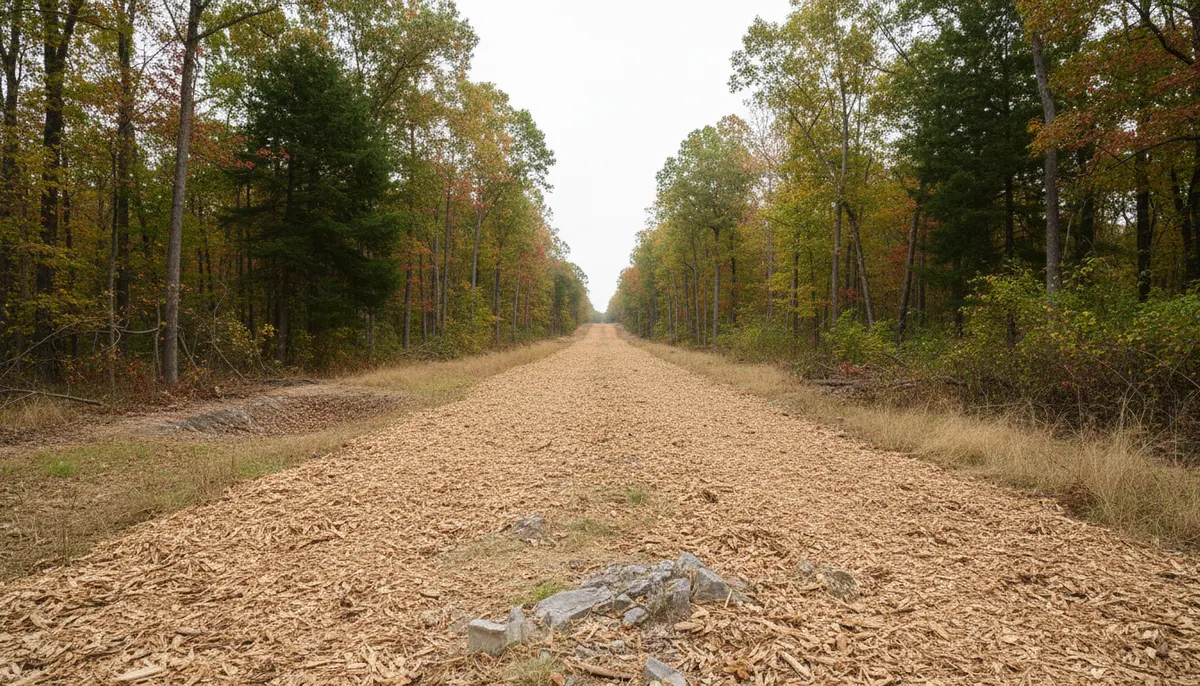
Right of way clearing in Clarksville, TN means keeping a defined corridor open: a utility easement, a pipeline strip, an access road to a back tract, a shared drive, or a verge that has closed in. Two jobs hide inside that phrase and they price nothing alike. An initial pass takes a corridor left alone for years back to full width. Cycle maintenance keeps an open corridor from closing, on an interval short enough that the head meets soft regrowth rather than standing timber. The corridor also has a legal shape, set out in an easement or on a plat, and that document fixes the width long before anyone puts a head to a stem. Where the corridor is a property line instead, the boundary version carries a different risk.
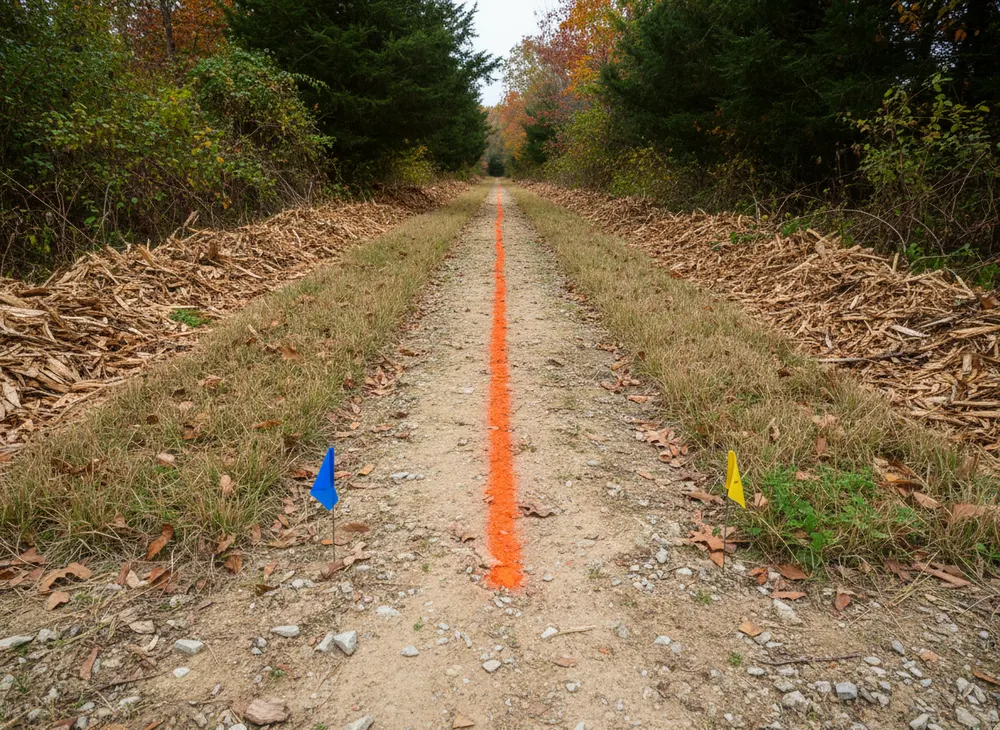
Corridors We Are Called Out To
Utility easements
Overhead distribution, buried service runs and the strips feeding a barn, a well or a pump. Cut to the granted width, no wider.
Access roads and shared drives
The long approach to a rear tract, cut back for turning room, sight lines and overhead clearance for a truck.
Pipeline and survey lines
Straight corridors held to a fixed width for patrol or resurvey, where width matters more than finish.
Machines and Passes Along a Corridor
Tracked carrier with a drum head
The default, because it works forward down a line and leaves material behind it as cover. The published guide is 70 or more horsepower for moderate brush and small trees, 100 or more for heavy-duty work.
Excavator head for the flanks
Carrier ranges run from 3.5 to 10 ton up through 15 to 45 ton. Reach takes edge stems from inside the corridor rather than from somebody else's ground.
Cutting height on a return visit
A maintenance pass runs higher than a first pass, leaving low cover that slows the next flush. Same machine, different price.
How a Corridor Job Is Sequenced
-
Read the easement first
Granted width, permitted activity and access conditions come off the document, not off the tape. That is the number the scope is written against.
-
File the locate tickets
The notice goes in before mobilisation, and on a long corridor it goes in as a series of tickets rather than one, because marks expire.
-
Flag every water crossing
Any point where the corridor meets a stream or wetland is marked on the walk, because a crossing is a permit question, not a cutting question.
-
Cut, then set the interval
The corridor is cut to width and the return interval is agreed in writing, so the next visit is a budget line, not a surprise.
Locates Come First on a Corridor, Not Last
What Tennessee 811 actually requires
A corridor is where buried facilities live, because the easement is the reason they were put there. So the locate does not close the job out, it sets the start date. Tennessee 811 requires at least three working days of notice, which is 72 hours excluding weekends and holidays, under the Underground Utility Damage Prevention Act at Tennessee Code 65-31-101. Once marks are down there is a tolerance zone of 24 inches on each side of the facility, plus the width of the facility itself, and inside that zone the work goes to hand tools. The ticket is good for 15 calendar days from the legal start date, and that number is what catches contractors out here. A quarter mile of closed corridor is easily more than fifteen days of cutting, so the ticket gets renewed by contacting 811 three working days before it expires, which means the renewal is booked when the job is booked, not when the marks fade. That becomes one rule on site: no machine moves onto a segment whose marks have expired.
A water crossing is a different permit question
Cutting vegetation is one thing. Putting a crossing in is another, and Tennessee treats it that way. Any alteration to a stream, river, lake or wetland requires a TDEC Aquatic Resource Alteration Permit or a Section 401 water quality certification, under the Tennessee Water Quality Control Act at Title 69, Chapter 3, and Section 404 of the Clean Water Act. Road and utility crossings sit on TDEC's own list of triggering activities, alongside excavation and filling a wetland. The timeline decides your programme: general permits typically run three to four weeks, individual permits must be processed within 90 days. Fees are $50 for a personal residence or family farm, $500 or nothing for a general permit depending on notification, and $2,500 or $5,000 for an individual permit. With no crossing built at all, the corridor still respects the stormwater permit's 30-foot riparian buffer, never narrower than more than 15 feet at any measured point.
Corridor Clearing Prices Around Clarksville
Tennessee bands run $1,430 to $2,210 per acre for medium growth and $2,080 to $3,250 for a heavy stand
Quoted per acre once the width is fixed, or hourly on maintenance where the ground is open. Published 2026 Tennessee ranges. Nothing here is a quote.
| Scope | Typical range | What it covers |
|---|---|---|
| Maintenance cycle, corridor already open | $125 to $300 per hour | Soft regrowth cut before it goes woody. The cheapest way to hold a corridor. |
| Medium growth, first pass | $1,430 to $2,210 per acre | Closed understory with small trees. 5 to 8 hours per acre. |
| Heavy forest and large stems | $2,080 to $3,250 per acre | A corridor lost to a mature stand. 8 to 10 or more hours per acre. |
What moves the price
- Corridor width, which converts to acreage and drives everything after it.
- Time since the last pass, since density alone spans a three to eight times range.
- Slope. Moderate grades add 20 to 30 percent, steep or rocky ground 40 to 60 percent.
- Stems over 6 inches in diameter, another 15 to 30 percent.
- Access at each end, roughly $500 to $1,500 in mobilisation on a hard site.
A 1,200-foot corridor cut to 30 feet is about 0.83 acre of disturbance. In the medium band that is roughly $1,190 to $1,840 of cutting, one to two days on site. Under an acre it sits below the county grading threshold, but state stormwater coverage still applies if the corridor forms part of a larger common plan of development.
What a Corridor Contract Includes
Width comes off the easement
We quote to the granted width, because cutting past it is trespass no matter who ordered the work.
Locates run as a programme
Tickets and renewals are scheduled against segments, so no crew starts a length whose marks have run out.
A stated return interval
The next visit is priced when the first one is, so maintenance never becomes an emergency.
Easement and Corridor Questions
What does right of way clearing actually mean?
Removing vegetation from a corridor somebody has a legal right to use or reach: an easement, an access road, a pipeline strip, a verge. The edges are fixed by a document, and the result is judged on width and clearance rather than tidiness.
Who is responsible for keeping an easement clear?
The instrument decides, and it varies. Some put the duty on the holder, some leave it with the landowner, some are silent. We work for whichever party engages us and quote to the granted width.
Can you cut under energised power lines?
Work inside the approach distances of an energised conductor is line clearance work and belongs to crews qualified and equipped for it. We take the corridor floor and the flanks, coordinated around that boundary, and we say so on the quote.
How often does a corridor need recutting?
Often enough that the head meets soft stems rather than woody ones, because that is roughly the difference between an hourly rate and a per-acre band. Root collars stay alive after a mulching pass and sprout from the cut, so an interval set after watching your own first regrowth beats a number off a chart.
What happens to the cut material?
It stays as a mulch layer, which holds soil on a strip that has just lost its cover and removes the disposal cost. Where the corridor has to be clean for patrol, it is chipped or hauled off at hourly or per-load rates.
Do I need a permit to clear an easement?
The trigger is disturbed area, not the word easement. One acre or more of clearing, grading or excavation brings in state stormwater coverage and the Montgomery County grading, drainage and erosion control requirement, and disturbance under an acre counts where it belongs to a larger common plan of development.
Scopes That Run Alongside Corridor Work
Cutting a strip along a property boundary shares the method but turns on where the line legally sits.
Putting a running surface down the middle is the next job once the corridor has to carry vehicles, not just stay open.
Holding soil on a freshly opened strip matters because a corridor is a long narrow route for water downhill.
Reopening a corridor after a blowdown is the urgent version, where hung and leaning stems come out first.
Book a Site Walk on Your Acreage
Send the parcel details and we will walk the ground, measure the disturbed area, check the stormwater threshold and put a written scope in front of you before any machine is booked.