Gravel Driveway Installation in Clarksville, TN
Long rural drives built as drainage first and stone second, with the crown, the ditches and the crossings decided before a single ton is delivered.
Get a Free Land Clearing Quote in Clarksville
Tell us the acreage, the road it fronts and what the ground has to do afterwards. Form requests are answered the same working day, and every quote follows a site walk.
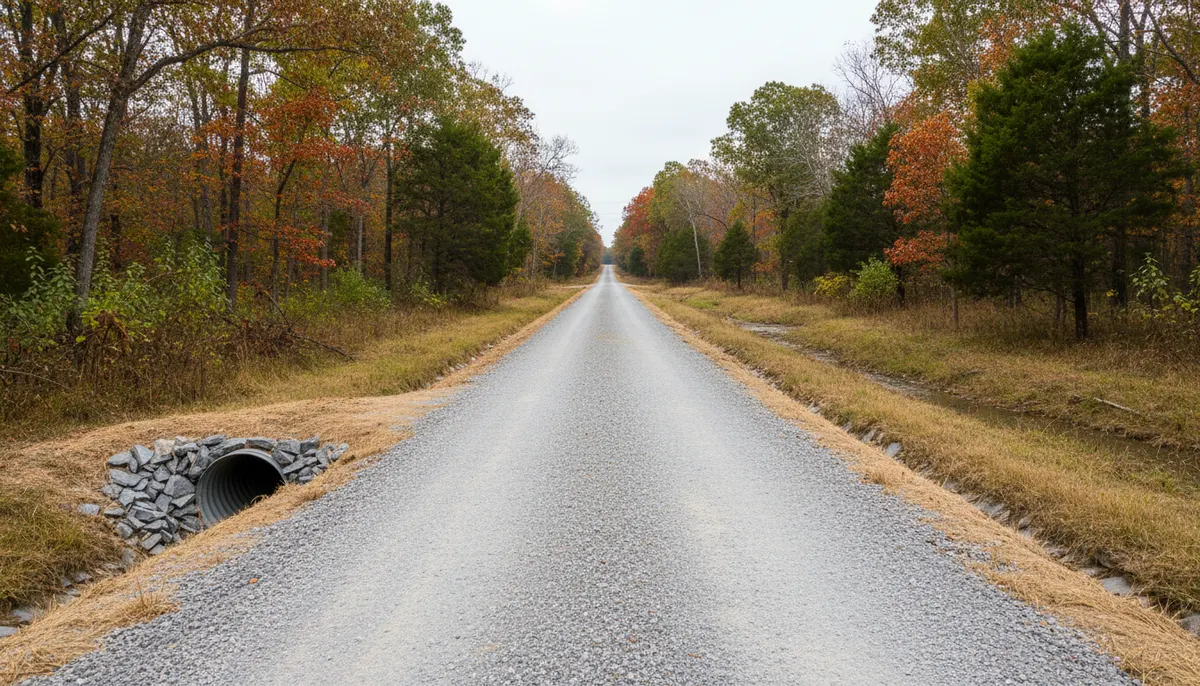
Gravel driveway installation in Clarksville, TN is a drainage job with stone on top of it. The common case is a long rural drive off a county road on one of the five-acre tracts that fill the county fringe. Those are quoted by length and running width rather than by the acre, because the cost sits in shaping, drainage structures and hauled tonnage. What fails a drive here is almost never the stone. It is water: 50.99 inches of rain a year, subsoils that hold it, and a surface built without a crown to shed it. The line usually has to be cleared and grubbed first, because roots left under a base course rot out and take the surface with them.
The Parts of a Drive That Do the Work
The subgrade under everything
Stripped of topsoil, roots and organic matter, then shaped and compacted. Every problem you get later starts here.
Base course, then surface course
A coarse layer that carries load, then a smaller crushed layer with enough fines to key together under a tyre.
Crown, shoulders and side ditches
The shape that moves water off the surface and along the drive instead of down it.
What Is On Site for a Drive Build
Excavator and dozer for the cut
Topsoil comes off and is stockpiled rather than buried, the line is cut to grade, and spoil goes where it will not block the ditch you are about to cut.
Compaction, in layers
Stone placed in lifts and compacted as it goes, because a thick uncompacted layer ruts under the first loaded truck.
Culvert pipe at the low points
Where the drive crosses a swale or a wet weather run, a pipe carries the flow under it. Size follows the area draining to that point, so it is set on site.
The Order a Drive Gets Built In
-
Walk the route and the water
We follow the proposed line looking for where water crosses it. Those points set the culverts and often move the line.
-
Locate, then clear and grub
Tennessee 811 gets at least three working days of notice before any digging. Then the corridor is cleared and the root mat comes out of the line.
-
Shape the subgrade and the ditches
Grade, crown and side ditches are cut before stone arrives. Building shape out of gravel afterwards costs more stone and works less well.
-
Place stone in lifts
Base first and compacted, surface second. The crown is carried through both so the finished drive sheds water instead of ponding.
Why Drainage Decides Whether the Stone Stays Put
Rainfall and the soils it sits on
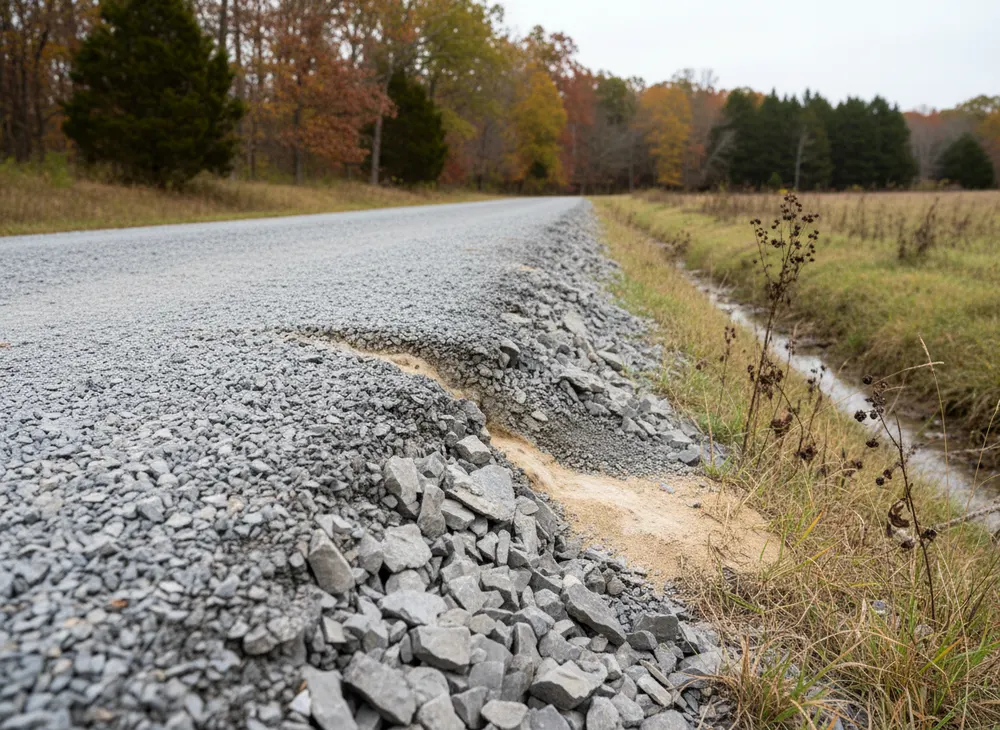
Clarksville takes 50.99 inches of rain in an average year and it does not arrive evenly. March through May bring 14.60 inches between them against 6.44 inches across August and September, and that spring load is what tests a drive. Underneath, the Dickson soils common on these tracts carry a fragipan, a dense layer that perches water rather than letting it drain away, so ground can look firm in April and turn to pudding once a loaded truck works it. Shape therefore matters more than tonnage. A drive with a real crown moves water sideways into ditches within a few feet of where it lands. A flat drive holds it, water finds the subgrade, and stone is pumped down into softened soil until the surface is ruts. Ditches also have to have somewhere to go, which is why the outfall gets walked before the line is fixed. Organic material is the other silent failure: roots, stumps and mulch under a base course rot, lose volume and leave voids, so the running line is grubbed rather than mulched even where mulching is cheaper. Where the drive ties into a wider build, grading the ground around it is worth solving at the same time.
Crossings, buffers and the acre line
A pipe under a farm drive in a dry swale is ordinary construction. A crossing of a blue-line stream is not. Tennessee requires a TDEC Aquatic Resource Alteration Permit or a Section 401 certification for alteration of a stream, river, lake or wetland, and road crossings sit on TDEC's list of triggering activities. General permits typically take three to four weeks and individual permits are processed within 90 days, with a fee of $50 for a personal residence or family farm. Away from any crossing, the construction stormwater permit still calls for a 30-foot riparian buffer, never narrower than more than 15 feet at any measured point. Length matters too: at a 20-foot working width a drive reaches an acre of disturbance at roughly 2,180 feet, which brings in the county grading and erosion control requirement and state stormwater coverage.
What Moves the Price of a Rural Drive
Quoted by length and running width, with the stone shown as its own delivered line
No published Tennessee figure covers this work per foot or per ton, so we do not print one. What follows are the sourced bands for the earthwork around it. Stone is quoted from the delivered price on the day.
| Scope | Typical range | What it covers |
|---|---|---|
| Clearing and grubbing the running line | $2,600 to $4,160 per acre | The Tennessee band for root and stump removal, which a drive needs and mulching does not deliver. |
| Grading and levelling, small sites | $2,000 to $5,000 | Shaping subgrade, crown and ditches on a typical residential job. |
| Machine and operator by the day | $2,600 to $4,000 per day | The Tennessee day rate, used on short drives and on repair rather than new build. |
What moves the price
- Length and running width, which set both the earthwork and the tonnage.
- Slope. Moderate grades add 20 to 30 percent, steep or rocky ground 40 to 60 percent.
- Rock and hidden debris, worth another 20 to 40 percent on this ground.
- Stumps in the line at $2 to $6 per inch of diameter, against an $80 to $160 minimum.
- Access. A site the trailer cannot reach adds roughly $500 to $1,500 in mobilisation.
A 600-foot drive at a 20-foot working width disturbs about 0.28 acre, well under the one-acre line. Grubbing that strip at the Tennessee band comes out around $730 to $1,160, shaping falls inside the grading range, and stone is added as tonnage at the delivered price.
How We Quote a Driveway
Drainage is priced before stone
Crown, ditch line and culvert points appear on the quote, because that is what a cheap bid leaves out.
Tonnage is shown separately
Stone is a delivered commodity and its price moves. A per-foot number hides which way it moved.
The running line is grubbed
Roots come out under the drive rather than being mulched over, because organic material under a base settles.
Questions About Building a Gravel Drive
Why does a drive need a crown?
Because water has to leave the surface in the shortest distance available. A crowned drive sheds sideways into the shoulders within a few feet. A flat one holds water, which works into the subgrade, softens it and lets traffic pump the stone down into the soil. On fragipan soils that failure comes fast, because the subsoil will not drain it away underneath.
Can the wood chips from clearing go under the drive?
No. Mulch, roots and stumps under a base course rot, lose volume and leave voids, and the surface follows them down. Mulch is useful cover on the slopes beside a drive, but it belongs beside the running line rather than under it.
What size culvert do I need?
It follows the area draining to that point and the shape of the swale, so it is a site question, and we will not publish a diameter that would be wrong on half the jobs. We walk the outfall as well as the inlet, because a pipe discharging into nothing moves the problem twenty feet.
Do I need a permit for a driveway?
It turns on disturbed area and on water. One acre or more of clearing, grading or excavation brings in the Montgomery County grading, drainage and erosion control requirement and state stormwater coverage. Crossing a stream or wetland is a separate permit with its own timeline. Where a new drive meets a public road, confirm entrance requirements with the county first.
How long before it needs work again?
The ditches decide that, more than the stone. A drive whose ditches stay open and whose crown is maintained needs topping up rather than rebuilding. Once ditches silt in, water runs down the wheel tracks and the repair becomes earthwork again rather than a delivery of gravel.
Work That Goes With a New Drive
Taking the root mat out of the running line separates a drive that lasts from one that settles into ruts.
Shaping the ground either side is usually quoted with the drive, because both solve the same water.
Getting a build pad ready at the end of it is the larger scope where the drive serves a house that is not built yet.
Stabilising fresh cut and fill keeps new banks and ditch lines out of the culvert during the first storm.
Book a Site Walk on Your Acreage
Send the parcel details and we will walk the ground, measure the disturbed area, check the stormwater threshold and put a written scope in front of you before any machine is booked.