Stump Grinding in Clarksville, TN
Stumps ground out and priced by the inch of diameter, with the finished depth written on the quote, because depth is what the next trade cares about.
Get a Free Land Clearing Quote in Clarksville
Tell us the acreage, the road it fronts and what the ground has to do afterwards. Form requests are answered the same working day, and every quote follows a site walk.
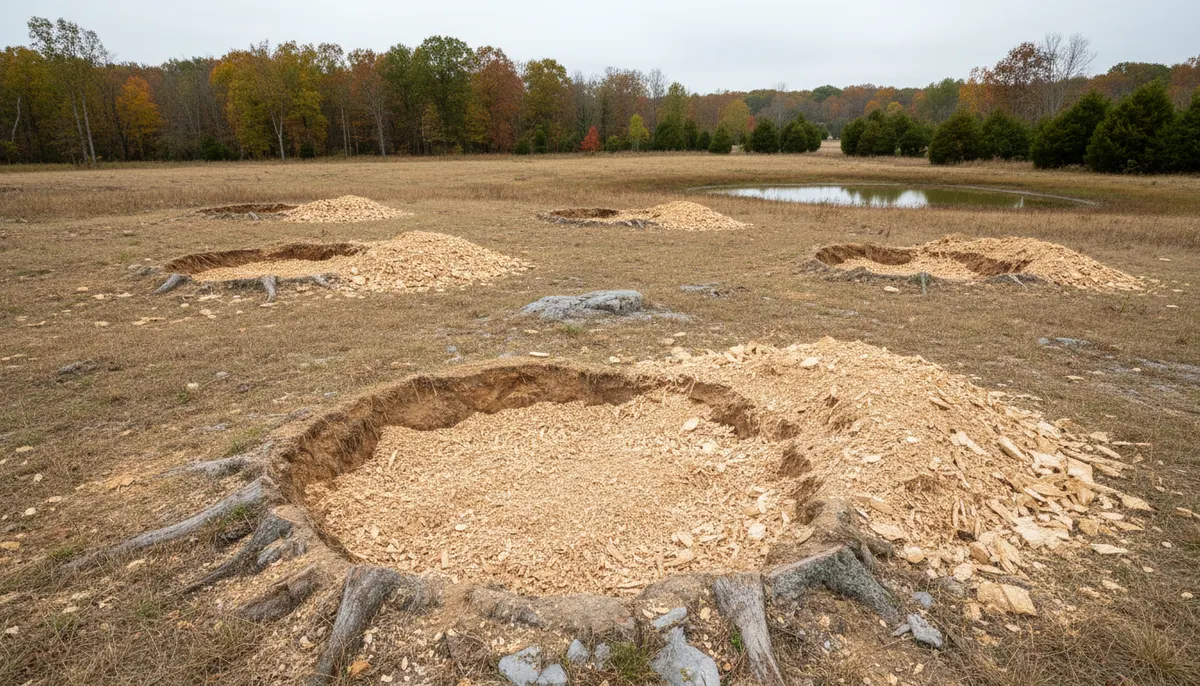
Stump grinding service in Clarksville, TN is quoted at $2 to $6 per inch of stump diameter, so you can estimate your own job. Measure across the widest point at ground level and multiply. What that will not tell you is the minimum charge of $80 to $160, which is why one small stump costs about the same as a slightly larger one.
Grinding is not removal. A wheel with carbide teeth chews the stump down through the soil surface to a depth you specify and turns wood into chips in place. The lateral roots stay. For turf that is right. Under a footing or a septic field it is not, and that decides whether you are buying grinding or full root removal.
Jobs a Grinder Gets Called To
Same unit price, very different economics.
One stump in a finished yard
The most common call and the worst value per stump, since the minimum governs. Access is the question: through a gate and across turf without ruts.
A cleared parcel full of them
Where per-inch pricing works for you. Additional stumps run $30 to $60 each on the same mobilisation, so twenty in one visit costs a fraction of twenty visits.
Stumps where something is going to be built
A pad, drive base or septic field. Grinding leaves the lateral roots in place, and organic material under load is a settlement problem, so the scope gets upgraded.
The Measurements That Set Your Price
Three numbers do nearly all the work.
Diameter, at ground level and not at breast height
Grinding is priced on the stump, so measure across the widest point where it meets the soil, including the root flare. That is larger than DBH, diameter at breast height: a white oak at 24 inches DBH can present a stump over 30 inches across the flare.
Count, because the second stump is cheap and the first is not
Published bands run $120 to $400 for a first stump and $30 to $60 for each additional one, against a minimum of $80 to $160. Loading, travel and setup happen once, so stumps should be scheduled together.
Depth, the only spec that matters to whoever comes next
A grind for turf and a grind under a driveway base are different jobs at different prices, and the difference is depth. It is the number most quotes leave off.
How the Work Runs on the Day
-
Locate before the wheel turns
Tennessee 811 notice runs three working days ahead under Tennessee Code 65-31-101, marks good 15 calendar days. A stump beside a house is often a stump beside a water, gas or irrigation line.
-
Measure, agree the depth, clear the base
Each stump is measured across the flare and the depth agreed against what goes on top. Loose rock is pulled clear, since a wheel throwing a buried stone is the main hazard.
-
Grind in passes, not in one bite
The wheel sweeps side to side, taking a controlled cut per pass. Forcing depth loads the teeth and stalls the wheel, costing more in carbide than it saves.
-
Decide where the grindings go
Chip volume is larger than the stump looked, because ground wood bulks up. They can be mounded, spread, or taken off site with the rest of the debris. What they should not become is backfill.
Two Things That Decide Whether a Grind Is Finished
Grindings are wood, and wood is not fill
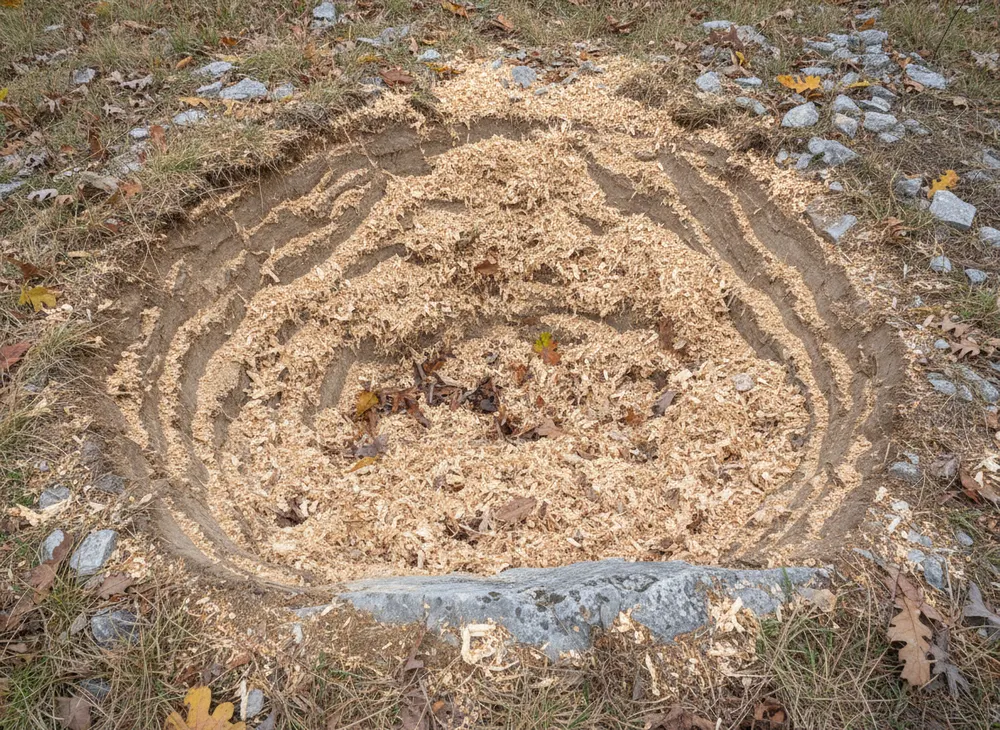
Raked out, the pile looks like soil and behaves nothing like it. It is shredded wood with a very high void ratio, and two things happen over the following seasons. It settles as those voids close under its own weight and rainfall, and it decomposes, losing volume as it goes. Backfill a grind hole with its own grindings, top it with topsoil and lay turf, and you get a dish in the lawn that deepens every season until the wood is gone. The same mechanism is why organic material is unacceptable under anything structural: a footing, slab or drive base bearing on ground that still contains wood settles unevenly, and differential settlement is what cracks concrete. If the hole has to come back to grade it comes back with mineral soil compacted in lifts.
On karst ground the rock is not where you assume
Montgomery County sits on a sinkhole plain over Ste. Genevieve and St. Louis limestone. In karst the bedrock surface is not a flat sheet at a predictable depth. It is dissolved, pinnacled and cut through with solution channels, and roots follow those channels. Two stumps 40 feet apart can behave differently: one grinds to the agreed depth, the other meets rock shallower because the limestone pinnacles up under it. Hitting rock is expensive in teeth and slow in production, and no amount of pushing turns limestone into chips. Where rock stops the grind above the specified depth we tell you where it stopped.
What Stump Grinding Costs Here
Stump grinding: $2 to $6 per inch of stump diameter
National 2026 cost-guide bands. Grinding is one of the few tasks where the national unit rate transfers cleanly.
| Scope | Typical range | What it covers |
|---|---|---|
| Per inch of diameter | $2 to $6 per inch | The unit the trade quotes in, measured at ground level. |
| First stump, and each one after | $120 to $400 first, $30 to $60 each additional | The gap is the argument for doing them in one visit. |
| Minimum charge and hourly work | $80 to $160 minimum, $100 to $200 per hour | The minimum governs single stumps. Hourly is fairer on awkward access. |
| Root chasing and full extraction | $75 to $150 per hour for roots, $100 to $400 per stump to extract | Extraction pulls the root ball rather than grinding it down. |
What moves the price
- Diameter, the base unit that drives everything else.
- Stump count, since each additional stump is $30 to $60 rather than a fresh minimum.
- Required depth, because a grind under a base course is deeper and slower than one under turf.
- Buried rock and debris, worth 20 to 40 percent on rocky ground and a real risk to carbide teeth.
A 30-inch white oak stump in an open back yard. At $2 to $6 per inch the arithmetic gives $60 to $180, but the $80 to $160 minimum applies, so a single stump is priced at the minimum. Add seven more averaging 18 inches at $30 to $60 each as additional stumps, and that is $210 to $420 on top, well below eight separate call-outs.
How We Quote and Finish a Grinding Job
Depth is written down
Every quote states finished depth against the intended use. If rock stops the cut above it, you hear where it stopped.
The grindings have a destination
Chips are mounded, spread or hauled, agreed before the machine starts.
Questions People Ask Before Booking a Grinder
Why does one small stump cost the same as a bigger one?
The $80 to $160 minimum charge. A 12-inch stump at $2 to $6 per inch is $24 to $72 of grinding, less than the cost of getting a machine to your property. The per-inch rate only governs once the job clears the minimum.
What is left in the ground after grinding?
The lateral root system. A grinder works vertically on the stump and the wood within the wheel path, and roots running away from that point remain. In turf or pasture that is fine. Under a footing they are organic material under load, and the correct scope is grubbing.
Can I build over a ground stump?
Not on a grind alone. Organic material loses volume as it decomposes and compresses under load, so a foundation bearing on soil that still holds root mass settles unevenly. For a pad or septic area the root mass has to come out, which in Tennessee sits in the grubbing band of $2,600 to $4,160 per acre.
What happens if you hit rock?
On limestone ground it happens. Rock can sit shallow under one stump and deep under another nearby. When the wheel meets it the grind stops there, and going deeper is a change of method rather than pressure.
Services Either Side of a Grinding Job
Taking the tree down in the first place produces the stump, and one crew doing both cuts it at a height a grinder can work with.
Pulling roots out instead of grinding them down is the scope wherever ground carries weight, since a ground stump leaves the lateral roots in place.
Getting the chip pile off the property is worth pricing at the same time, because ground wood bulks up well beyond the stump.
Bringing the finished holes back to grade is the follow-on where several stumps sit in an area that needs to shed water.
Book a Site Walk on Your Acreage
Send the parcel details and we will walk the ground, measure the disturbed area, check the stormwater threshold and put a written scope in front of you before any machine is booked.