Land Grading in Clarksville, TN
Cut, fill and finished grade set so water leaves the structure, with county permit fees and the stormwater inspection cadence priced into the same contract.
Get a Free Land Clearing Quote in Clarksville
Tell us the acreage, the road it fronts and what the ground has to do afterwards. Form requests are answered the same working day, and every quote follows a site walk.
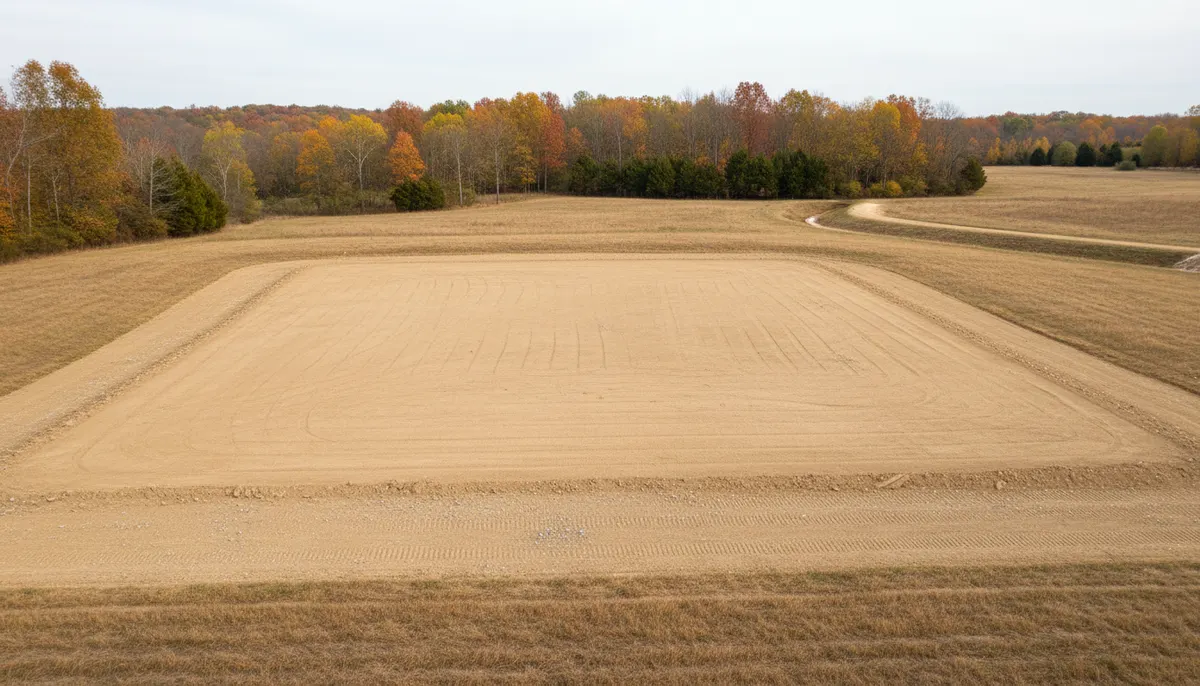
Land grading services in Clarksville, TN are judged on where the water ends up, not on how flat the ground looks the day the machine leaves. A yard can be cut dead level and still hold water for a week, because Dickson-series silt loams here carry a fragipan, a dense restrictive layer that perches water above it. Reshape the surface without giving that water a fall to follow and you get ground that turns to soup in March.
The county takes 50.99 inches of rain a year, 14.60 of it across March, April and May against 6.44 across August and September. Much of the traffic here is some version of land clearing and grading near me, which is how the work arrives: vegetation off and ground shaped on one mobilisation. Where trees still stand, what happens first sets the take-off.
Grade Work Quoted as Separate Line Items
Four scopes, priced apart, because owners often need one now and the rest later.
Rough grading and bulk cut and fill
Volume moved toward design elevation, cut balanced against fill so nothing is imported or exported. A pad 18 inches out here stays expensive through finish.
Finish grading around a structure
Positive fall away from foundations, slabs and crawl space vents, tied into a route that exists rather than into a neighbour.
Swales, berms and outlets
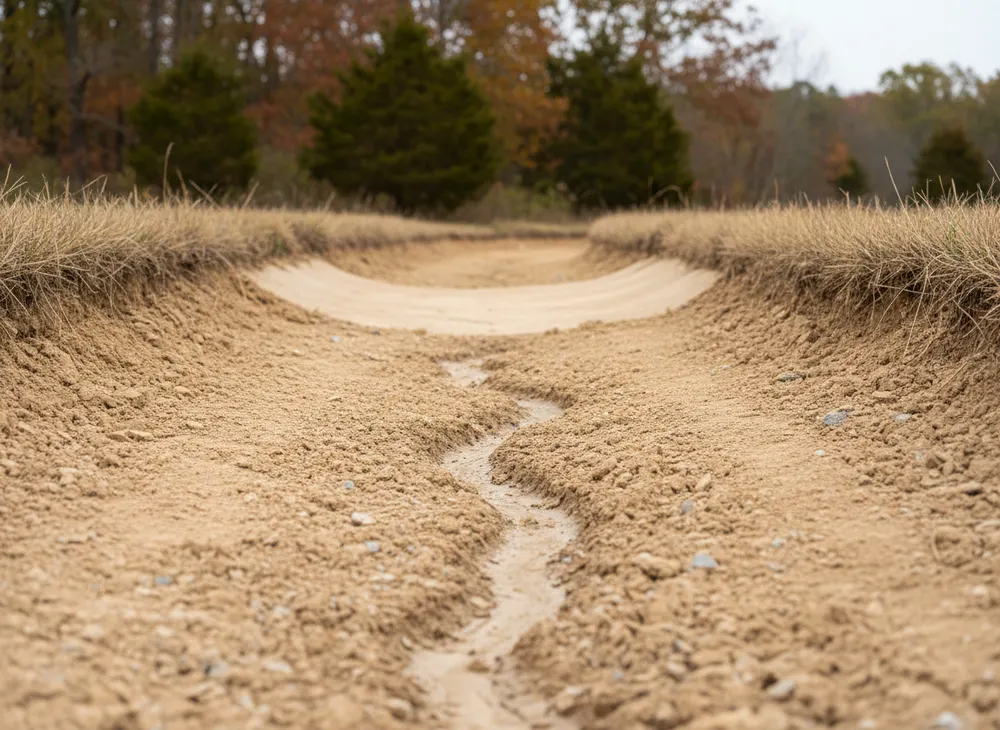
Drainage shaped into the grade rather than added later. On fragipan ground this is usually what solves the problem.
Driveway and access grading
Crown, cross-fall and side ditching so a rural run sheds water instead of channelling it.
Ground Conditions and Plant That Actually Show Up
What sits under this county, and which machine handles it.
The fragipan, and why more cut will not beat it
Water reaching the restrictive layer in a Dickson-series profile stops and perches. The fix is a swale, a drain line or an outlet with real fall.
Karst under the cut
A sinkhole plain over Ste. Genevieve and St. Louis limestone means a deep cut can find voids, and stormwater there goes into groundwater rather than a ditch. The digging side is its own conversation.
Dozer, excavator and the compaction question
A dozer moves volume and holds a plane; an excavator cuts structures and tie-ins. Topsoil is stockpiled rather than buried, because organics in a lift decay and the surface settles in year two.
How an Earthwork Contract Runs Here
Five steps, ordered by permit lead time and the outlet.
-
Walk the site and find the outlet
Settled before any elevation is discussed. No outlet with fall on it means grade alone cannot fix the problem.
-
Plans and stormwater coverage
Grading, Drainage and Erosion Control plans go to county Building and Codes before earth disturbing activity begins.
-
Locates and perimeter controls
Tennessee 811 needs three working days under Tennessee Code 65-31-101, with a 24-inch tolerance zone each side of a marked line.
-
Strip, stockpile, cut and fill
Topsoil to a stockpile inside the limit of disturbance. Structural fill in lifts, compacted rather than pushed.
-
Finish, stabilise and document
Surface shaped to the design, then seeded or matted inside the deadline for that portion of the site.
The Stormwater Layer Sitting On Top of Any Real Grade
One acre of disturbance changes what the job is
A contractor measures grading in cut and fill volume. The regulator measures it in disturbed acres, and the second number sets the calendar. Clearing, grading or excavation resulting in one or more acres of disturbance brings a site under the Tennessee construction general permit, number TNR100000, and a smaller area does the same within a larger common plan of development. The notice of intent carries a site-specific stormwater pollution prevention plan with it, and the permit asks for that complete application at least thirty days before construction activities commence. Montgomery County adds its own layer under Resolution #13-2-2: Grading, Drainage and Erosion Control plans before any earth disturbing activity begins, grading permit at $65 per acre, plan review at $50, a $10 archives fee.
Buffer width, the stabilisation window and whose signature is on the inspection
A 30-foot natural water quality riparian buffer is to be preserved between a waterbody and the disturbed area to the maximum extent practicable, floored at more than 15 feet at any measured location, so a parcel with a blue-line stream loses usable width before a blade drops. Stabilisation, temporary or permanent, is required within two weeks after activity in that portion of the site has ceased, and within one week on steep slopes. The county also requires stormwater controls to be inspected by someone holding Tennessee EPSC Level 1 certification at least twice a week, no less than 72 hours apart, plus a documented inspection immediately before and after a rain event. Ask a grading contractor who on the crew holds it.
What Shaping Ground Costs Around Montgomery County
Machine and operator at $2,600 to $4,000 a day in Tennessee, small-site grading between $1,000 and $5,000
Published 2026 figures, Tennessee day rates apart from national small-site ranges.
| Scope | Typical range | What it covers |
|---|---|---|
| Machine and operator, Tennessee day rate | $2,600 to $4,000 per day | How grading is priced past a yard. |
| Grading and levelling, small sites | $1,000 to $5,000 | Bracketed by $1,000 to $3,300 and $2,000 to $5,000. |
| Clearing first, where ground is grown over | $975 to $3,250 per acre | Light $975 to $1,560, medium $1,430 to $2,210, heavy $2,080 to $3,250. |
| County permit layer | $65 per acre permit, $50 per acre review, $10 archives | Subdivision work is tiered, $250 to $1,000 by acreage. |
| State stormwater coverage | $250 at 1 to 5 acres, $1,000 at 5 to 20 acres | Reaching $3,000 at 20 to 50 acres, plus annual fees past a year. |
What moves the price
- Whether a legal outlet with fall exists, which decides grading against drainage work.
- Slope. Moderate grades add 20 to 30 percent, steep or rocky 40 to 60.
- Rock and hidden debris, another 20 to 40 percent.
- Disturbed acreage, which sets county fee and state band together.
Two acres of disturbance: driveway approach, house surrounds and a swale to a road ditch, cut and fill balanced on site. Three days of machine and operator at the Tennessee day rate puts the earthwork between $7,800 and $12,000. Crossing one acre, the county adds $130 at $65 per acre, $100 in review at $50 per acre and a $10 archives fee, and state coverage in the 1 to 5 acre band adds $250. That is $490 of permit against a national guide figure near $200.
What You Get From This Crew on Earthwork
An outlet identified before an elevation is promised
Where water can legally and physically go, established before we quote.
Fill placed in lifts and compacted
Topsoil stockpiled, organics kept out of structural fill, lifts compacted.
The permit and inspection layer named at quote
Fee bands, submittals and inspection cadence appear as their own lines.
Grading Questions People Ask on the Walk
My yard was graded already and it still holds water. Why?
Usually because the water was never given an outlet, or because the soil has a fragipan: a dense restrictive layer that perches water above it, so rainfall stops moving down whatever the surface shape.
Do I need a permit to grade my own property?
Above one acre of soil disturbance, on both counts. The county requires Grading, Drainage and Erosion Control plans before earth disturbing activity begins under Resolution #13-2-2, and state permit TNR100000 covers clearing, grading or excavation disturbing one or more acres, or less within a larger common plan. Below an acre the county form states no minimum, so we confirm rather than claim an exemption.
What does the 30-foot riparian buffer do to a grading plan?
It removes width. The permit calls for a 30-foot natural water quality riparian buffer between a waterbody and disturbed ground to the maximum extent practicable, floored at more than 15 feet at any point. On a narrow lot with a blue-line stream, that decides where a pad sits.
How soon after grading does ground have to be stabilised?
Within two weeks after activity in that portion of the site has ceased, one week on steep slopes. That is why grading is phased.
Does clearing come before grading, or can they run together?
Clearing first, and where footings or a septic field are going the roots come out too. Grade over a root mat settles as organics break down. That is the scope with roots removed.
What Sits Either Side of the Earthwork
Taking a raw parcel through to a build-ready pad wraps this into a sequence of locates, clearing, grubbing and controls.
Keeping shaped soil where you put it carries its own certification requirement, and a fresh grade is the most vulnerable surface on site.
Digging below the finished surface raises the karst question, because limestone here puts voids under a cut.
Shaping a wooded lot for a house adds a grubbed pad, a topsoil stockpile and a drive that carries concrete trucks.
Book a Site Walk on Your Acreage
Send the parcel details and we will walk the ground, measure the disturbed area, check the stormwater threshold and put a written scope in front of you before any machine is booked.