Lot Clearing in Clarksville, TN
Rural tracts and suburban parcels cleared to a marked boundary, priced by what is standing on them, with the disturbed area measured before booking.
Get a Free Land Clearing Quote in Clarksville
Tell us the acreage, the road it fronts and what the ground has to do afterwards. Form requests are answered the same working day, and every quote follows a site walk.
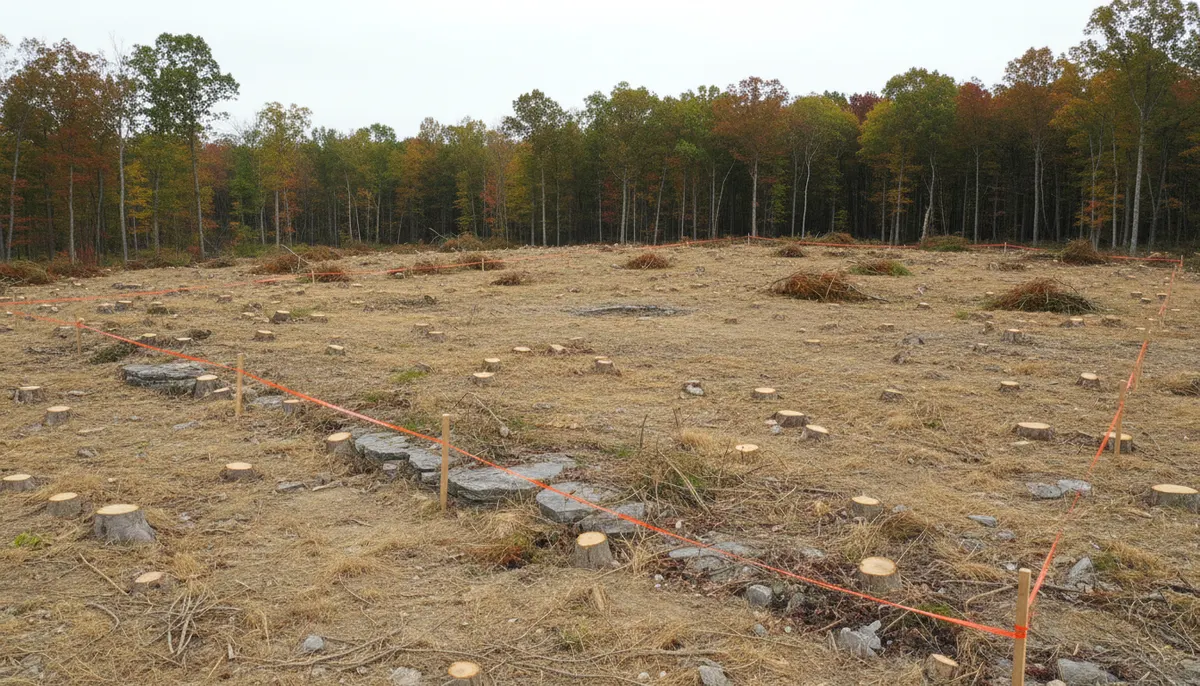
Lot clearing services in Clarksville, TN cover a quarter-acre back lot through to a five-acre rural split with no access cut yet. Price follows vegetation density, not deed size: light brush and grass, medium brush with small trees and heavy forest are three bands, and density alone creates a three to eight times spread on identical acreage.
The second number is the soil area you intend to disturb, which sets your permit position and is rarely the acreage on the plat. If the ground has to carry a house, taking the root mat out is a separate scope with its own cost band.
Four Lots, Four Different Scopes
Most of what gets quoted on Montgomery County ground.
The five-acre rural split
Part pasture, part woods, no cut access. Clearing is usually partial: a lane in, a working area, the rest standing.
The suburban infill lot
Under an acre, neighbours on three sides, no room to windrow. Quoted per job: debris handling fills the day.
The wooded homesite
Bought for the canopy, and it still needs a pad, a drive and a septic area. Flagged with the owner first.
The lot that has to drain first
Low ground or a swale through the middle. Clearing exposes a drainage problem rather than fixing it, so the cut is planned around where water sits.
What Is Actually Standing on a Parcel Here
Species, soil and rock decide how a lot cuts, and none show on a satellite image.
An oak and hickory forest, privately held
Oak and hickory make up 69.7 percent of Tennessee forest land, and 83 percent of it is privately owned. By volume: yellow-poplar 11.6 percent, white oak 9.2 percent, chestnut oak 8.2 percent. A lot listed as wooded is usually the heavy band.
Silt loams, with a fragipan under some of them
Pembroke, Dickson and Mountview silt loams cover most of this county. The Dickson series carries a fragipan, a dense layer that perches water above it, so a lot firm in August will not carry a loaded trailer in April. March through May brings 14.60 inches of rain against 6.44 across August and September.
Limestone, and the voids in it
Montgomery County sits on a sinkhole plain over Ste. Genevieve and St. Louis limestone. Voids and solution channels are possible under any parcel, and they matter most on grubbing and dozer work.
How a Lot Gets Quoted and Then Cut
-
Walk the boundary and agree the limit of work
We walk the pins with you and agree where cutting stops. Satellite imagery is not a survey.
-
Measure the disturbance, not the deed
A five-acre tract where only the pad, drive and septic area open up can sit under an acre. A two-acre lot cleared corner to corner does not.
-
Place the locate ticket
Tennessee 811 notice runs three working days ahead under Tennessee Code 65-31-101, marks stay good 15 calendar days, and a 24-inch tolerance zone applies either side of a marked facility.
-
Cut in sequence, then deal with the material
Access first, then the working area, then the edges. The debris route is decided before cutting starts, because chipping, hauling and burning carry different costs and calendars.
The Five-Acre Rule Behind Most Rural Lots Here
Section 1.5.3 is a planning exemption, not a certificate of anything
Montgomery County subdivision regulations exempt divisions creating tracts of land, including the residual parcel, that are five or more acres in size when no street or utility is to be constructed, from Planning Commission review. That clause is why the rural fringe here is a patchwork of five-acre splits: the smallest piece a seller can carve off without platting. The same section warns that those exempt tracts carry no guarantee or warranty of adequate access, of utilities, of freedom from environmental constraints, or of soils for installing an on-site septic system at average cost. Read plainly, the county reviewed nothing about your parcel. So the walk covers what nobody checked: access off the road, where the ground falls, and whether a blue-line stream in the low corner takes usable width out of the job through the 30-foot riparian buffer.
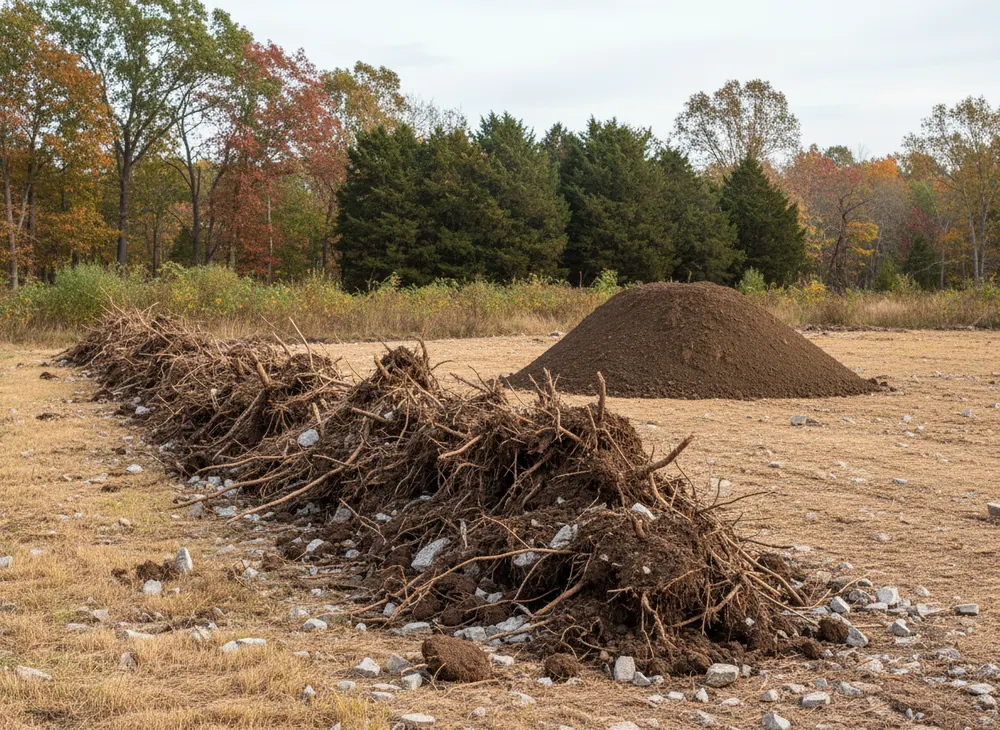
A dozer blade will put your topsoil in the burn pile unless somebody says otherwise
Conventional push-and-pile clearing is faster than a mulching head on open ground with good access, and on the right lot it is the cheaper answer. A blade run at speed takes vegetation, root mat and the top few inches of soil together, and that horizon holds the organic matter and the seed bank. Piled with the brush it gets burned, hauled or spread back as a mixed material full of wood. The fix has to be specified: strip and stockpile topsoil separately before the clearing pass, and put it back at the end.
What Lot Clearing Costs Around Clarksville
General land clearing in Tennessee: $1,300 to $4,500 per acre
Tennessee per-acre figures from a published 2026 state cost guide. Small suburban lots are quoted per job against a Tennessee day rate of $2,600 to $4,000.
| Scope | Typical range | What it covers |
|---|---|---|
| Light brush and grass | $975 to $1,560 per acre | Thin cover, open ground. 3 to 5 hours per acre. |
| Medium brush with small trees | $1,430 to $2,210 per acre | The common county fringe condition. 5 to 8 hours per acre. |
| Heavy forest with large trees | $2,080 to $3,250 per acre | A closed oak and hickory stand. 8 to 10 or more hours per acre. |
| Grubbing, where roots leave as well | $2,600 to $4,160 per acre | The highest band of any clearing scope in Tennessee. |
What moves the price
- Vegetation density, worth a three to eight times spread on its own.
- Slope, adding 20 to 30 percent on moderate ground and 40 to 60 percent on steep or rocky.
- Stem size, where trees over 6 inches in diameter add 15 to 30 percent.
- Access, where a parcel a trailer cannot reach adds $500 to $1,500 in mobilisation.
- Acreage, since five acres and up carries a volume discount of 10 to 25 percent.
A five-acre tract where only the building area, drive and septic field open up, about eight tenths of an acre of disturbance in medium brush. At the Tennessee medium band that is $1,144 to $1,768. State construction permit coverage triggers at one or more acres, or under an acre within a larger common plan, so we take the measured figure to Building and Codes before quoting. Open all five acres instead and the county grading permit at $65 per acre, plan review at $50 per acre and the $250 state fee at 1 to 5 acres all apply.
How We Handle a Lot Job
The disturbance figure is written down
The measured disturbed area and the permit position it creates go on the quote.
Debris handling is priced, not left vague
The disposal route is chosen and costed up front, not left as a change order.
What Landowners Ask Before Booking a Lot
Does clearing my lot need a permit?
It depends on soil disturbed, not lot size. One or more acres triggers Montgomery County Stormwater Management Regulations under Resolution #13-2-2: grading, drainage and erosion control plans before earth disturbing activity begins, plus coverage under state permit TNR100000. Under an acre is caught if part of a larger common plan.
How long are the utility marks good for?
Fifteen calendar days from the legal start date, with notice three working days ahead and renewal requested three working days before expiry. The 24-inch tolerance zone each side of a marked facility is hand-dig area.
Will the stumps be gone when you finish?
Not unless the quote says so. A clearing pass takes what is above ground. Removing stumps and root mat is grubbing, at $2,600 to $4,160 per acre. For a handful of stumps, grinding priced by the inch is cheaper.
Can I burn the brush pile afterwards?
Between October 15 and May 15 a Tennessee Division of Forestry permit is required for debris pile fires, obtained on the day and valid that day only. State rules cap a burn at 48 hours, limit it to twice in 30 days, and prohibit burning most vegetation not grown on site.
Work That Usually Follows a Lot Job
Turning cleared ground into a build-ready pad is the next scope: topsoil, cut and fill, compaction and erosion controls.
Grinding the cover in place instead of hauling it suits parcels where material can stay as a mulch blanket, removing the disposal line.
Putting in access that carries a concrete truck is worth doing early, since every later trade arrives on that drive.
Holding the soil once the cover is off stops being optional above an acre, with stabilisation due within two weeks of work ceasing.
Book a Site Walk on Your Acreage
Send the parcel details and we will walk the ground, measure the disturbed area, check the stormwater threshold and put a written scope in front of you before any machine is booked.