Land Clearing and Excavation in Clarksville, TN
Where clearing stops and digging starts, on ground where limestone solution channels and voids are a real excavation risk.
Get a Free Land Clearing Quote in Clarksville
Tell us the acreage, the road it fronts and what the ground has to do afterwards. Form requests are answered the same working day, and every quote follows a site walk.
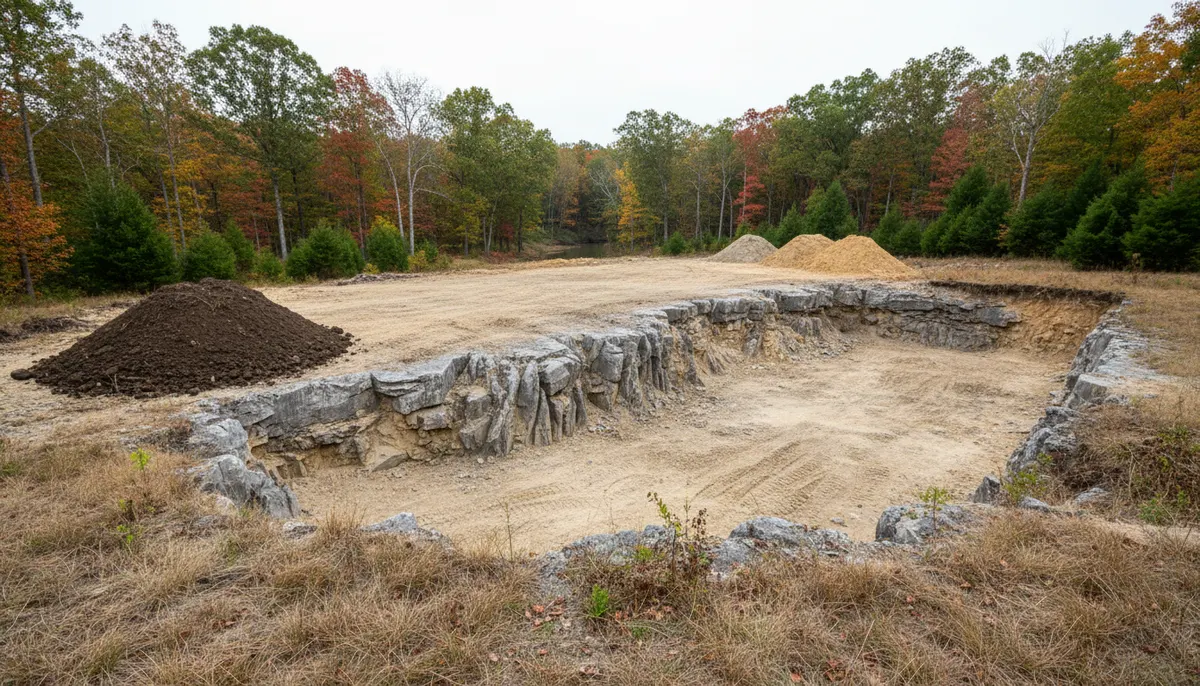
Land clearing and excavation in Clarksville, TN are two trades quoted as one line and should not be. Clearing takes what is above the soil. Excavation moves the soil, and the moment a bucket goes below grade the job picks up locates, spoil handling, compaction standards and the chance of finding a void nobody drew.
Where the Two Trades Meet
Footings and building pads
Clearing produces a flat area. Footings need bearing soil at a set elevation and subgrade compacted in lifts.
Utility trenches
Water, electric, septic and conduit. Depth, bedding and backfill are specified work, inside a locate ticket.
Ponds and impoundments
A dug pond is excavation plus a water question. Anything touching a stream or wetland is a permit conversation first.
Driveways, culverts and cuts
Access work cutting a bank, setting a pipe or building a base.
The Ground Under Montgomery County
A sinkhole plain on limestone
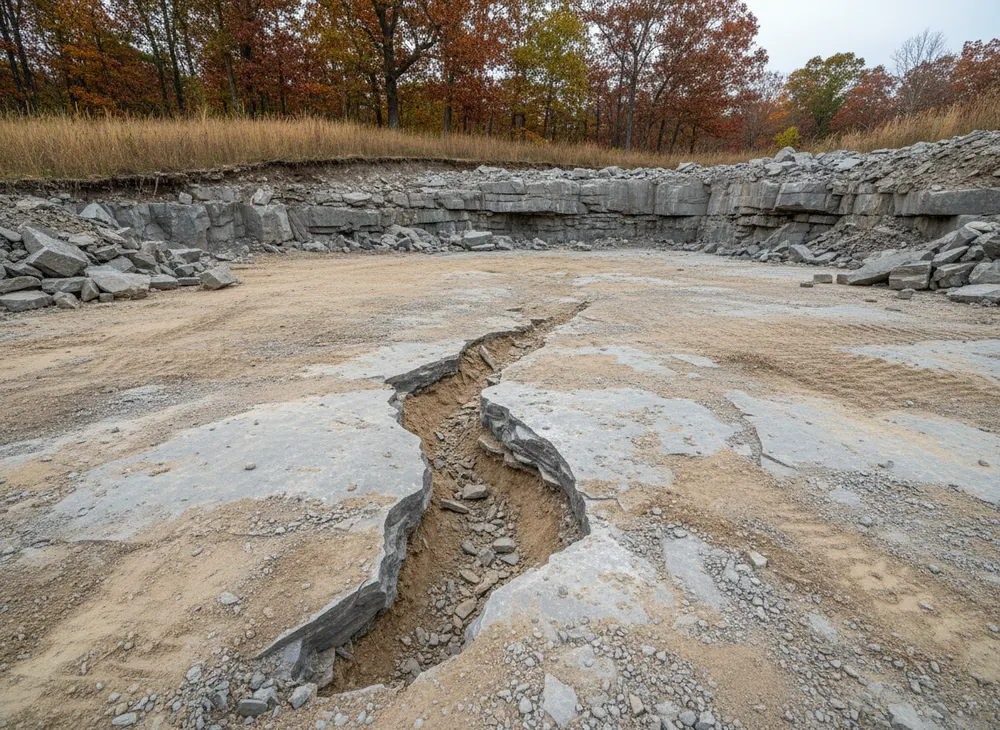
The county sits on Ste. Genevieve and St. Louis limestone. That is karst: solution channels, closed depressions and voids, with Dunbar Cave inside the city limits as the proof.
Where the water goes
On karst, stormwater moves to groundwater through the rock, not to a ditch. A design assuming runoff behaves as on clay will be wrong.
Rock at working depth
Limestone close to the surface changes trench cost and method.
Sequence From Standing Timber to Finished Grade
-
Clear, then grub
Vegetation off, then stumps and root mat out, because a root under fill rots.
-
Locate before the bucket
Tennessee 811 notice filed and marks confirmed before any digging.
-
Cut, fill and compact
Material placed to design elevation in lifts, topsoil stockpiled.
-
Drain and stabilise
Water routed deliberately, disturbed soil covered in the required window.
What Karst Does to an Excavation Plan
Voids are a method risk, not a talking point
On a sinkhole plain the rock beneath a site has been dissolving along joints and bedding planes for a very long time, leaving solution channels, enlarged fissures and occasionally open voids under a soil cover that looks ordinary from the surface. The consequences are specific. A loaded machine can drop a track into a soil-filled throat that gave no surface sign. Fill placed over a soil bridge above a channel can settle years later, under a slab. A trench that hits a fissure loses its bedding into the rock. None of that makes excavation here unusual, but an honest plan allows for the method changing mid-job. When a hole starts taking spoil without filling, the answer is to stop, look at what is below and price the fix.
Locates, licensing and the water question
Tennessee 811 requires at least three working days of notice under the Underground Utility Damage Prevention Act, TCA 65-31-101, with a tolerance zone of 24 inches each side of a marked facility and a ticket good for 15 calendar days. A Tennessee contractor licence is required where the total project cost is $25,000 or more. The Board classification for clearing is HC-5, Clearing, Grubbing, Snagging and Rip Rap, and excavation sits under BC-28, which carries the Board own note that excavation contractors should check with the Department of Environment and Conservation. That points at the water rules: altering a stream, wetland or watercourse, including crossings and pond work, requires a TDEC Aquatic Resource Alteration Permit, with general permits typically three to four weeks and individual permits processed within 90 days.
Clearing and Digging Prices Around Here
$2,600 to $4,160 per acre to clear and grub, with machine and operator at $2,600 to $4,000 per day
Tennessee and national 2026 cost-guide ranges, quoted after a site walk.
| Scope | Typical range | What it covers |
|---|---|---|
| Clearing and grubbing | $2,600 to $4,160 per acre | Roots and root mat out, which excavation needs under it. |
| Heavy forest clearing | $2,080 to $3,250 per acre | Standing timber only, before digging. |
| Machine and operator | $2,600 to $4,000 per day | For work that cannot be scoped by the acre. |
| Grading and levelling | $1,000 to $5,000 on small sites | Two national guides bracket these ends. |
| Contractor hourly | $110 to $250 per hour | How change work and unforeseen ground are charged. |
What moves the price
- Depth and volume moved, the real unit under an acreage price.
- Rock and hidden debris, a documented 20 to 40 percent factor.
- Moderate slopes add 20 to 30 percent, steep or rocky terrain 40 to 60 percent.
- Difficult access adds $500 to $1,500 in mobilisation.
- Whether spoil stays on site or is hauled off.
A worked example. A one-acre wooded homesite cleared and grubbed at $2,600 to $4,160, then two days of machine and operator at $2,600 to $4,000 per day to cut the pad, is $7,800 to $12,160 before trenching.
How We Price Below-Grade Work
Clearing and digging are separate lines
You see what the timber cost and what the dirt cost.
Rock and voids are handled openly
An allowance is stated up front, unforeseen ground charged at a named rate.
Locates before the bucket, every time
The three working day notice is in the programme.
Excavation Questions
How do I know if my parcel has karst features on it?
Closed depressions that hold no water after rain, a stream that disappears at a rock face, and springs that flow after storms are the surface clues. USGS publishes a statewide dataset of depressions and sinking streams in Tennessee karst areas.
Is grinding a stump enough before you excavate over it?
No. Grinding takes the stump below grade and leaves the root system in the soil, which is fine under lawn or pasture. Under a footing, a slab or a driveway base the root mat has to come out, because buried wood decomposes.
When does excavation need a stormwater permit?
Clearing, grading or excavation disturbing one or more acres triggers coverage under the Tennessee Construction General Permit, TNR100000, or less where the work is part of a larger common plan. The notice of intent goes in 30 days before work starts.
Do I need a permit to dig a pond?
Possibly, and it is worth checking before the machine is booked. Excavating, filling, draining or flooding a wetland, and altering a stream or watercourse, requires a TDEC Aquatic Resource Alteration Permit.
Do I have to call 811 on my own land?
Yes. The requirement is at least three working days of notice, 72 hours excluding weekends and holidays, and it attaches to the excavation rather than the ownership. The tolerance zone is 24 inches either side of the mark, and a ticket lasts 15 calendar days.
Work That Sits Around an Excavation
Getting roots and root mat out first decides whether the fill above stays put.
Setting the finished surface and its falls separates a site that drains from one that ponds.
Holding disturbed soil while the work runs has deadlines of two weeks after activity ceases, one week on steep slopes.
Book a Site Walk on Your Acreage
Send the parcel details and we will walk the ground, measure the disturbed area, check the stormwater threshold and put a written scope in front of you before any machine is booked.