Selective Clearing and Underbrush Removal in Clarksville, TN
The understory taken out, the mature oak and hickory left standing, and an honest answer about how long the ground stays open.
Get a Free Land Clearing Quote in Clarksville
Tell us the acreage, the road it fronts and what the ground has to do afterwards. Form requests are answered the same working day, and every quote follows a site walk.
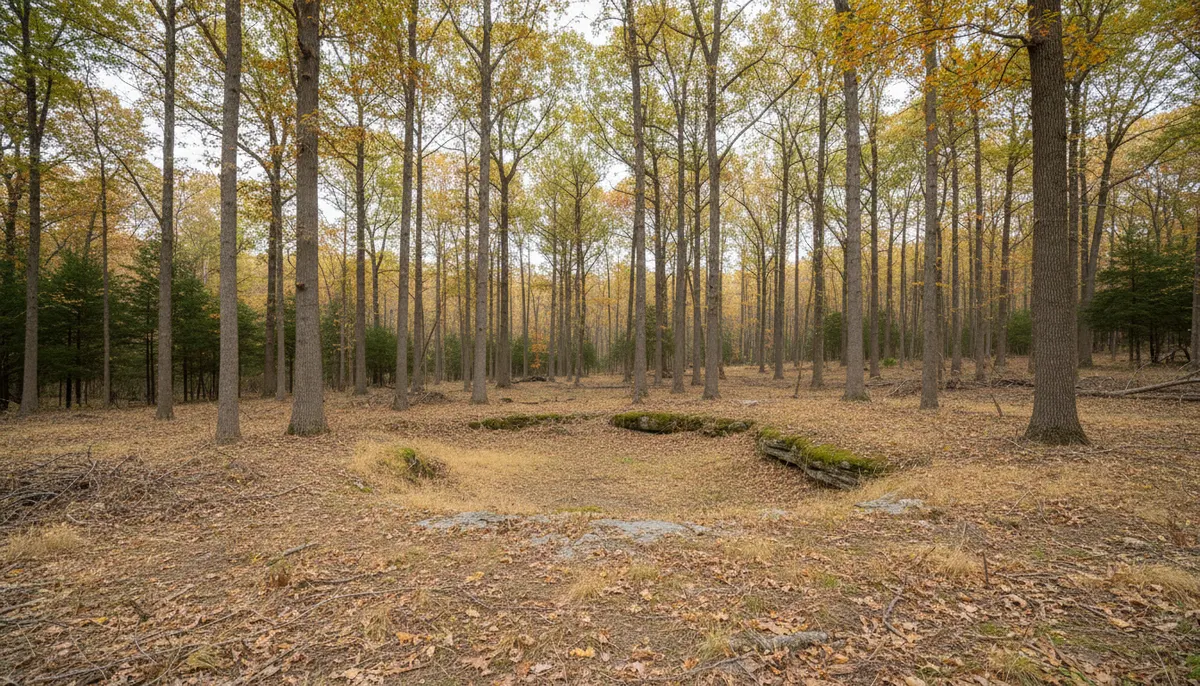
Selective clearing and underbrush removal in Clarksville, TN takes out the understory and leaves the stems worth keeping. Briar, honeysuckle, greenbrier and volunteer red maple and sweetgum come out; the canopy stays. Oak and hickory account for close to 70 percent of Tennessee forest land by type group, so most parcels here have a stand worth protecting. It is slower per acre and priced higher, the trade for shade and screening. Where nothing standing is worth keeping, clearing the whole footprint is cheaper.
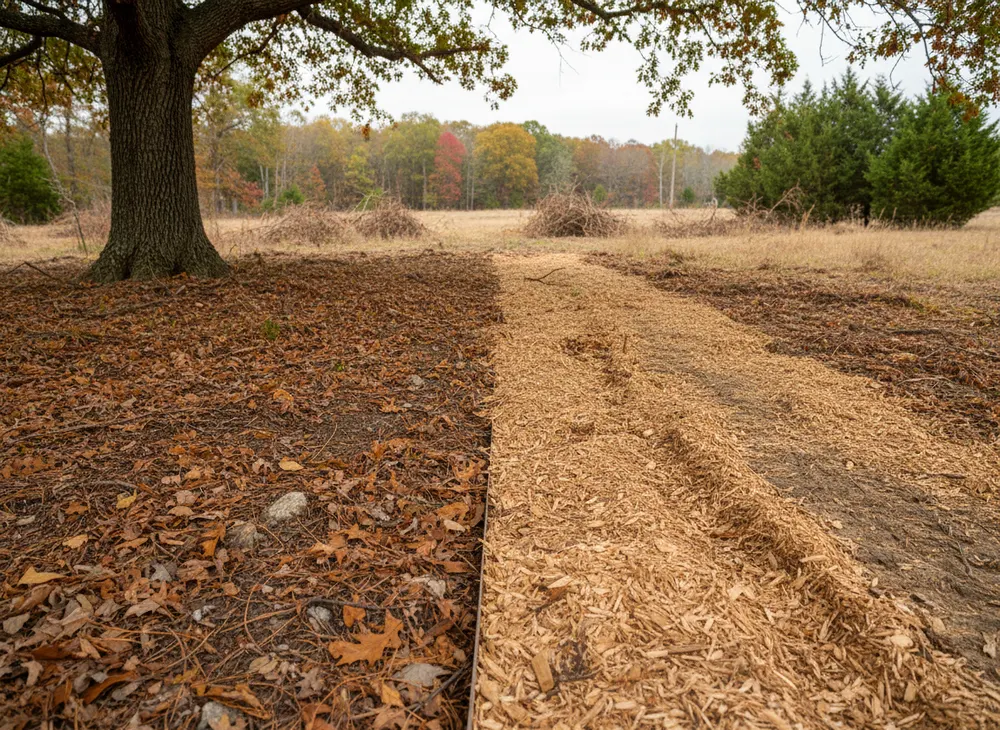
What We Cut and What Stays
Understory and Briar
Briar, honeysuckle, cane and volunteer stems between ankle and head height.
Thinning a Crowded Stand
Codominant stems, suppressed trees and stems leaning over a drive get taken; the straight oaks stay.
Trails and Sight Lines
Corridors cut for access, a view opened, the property line made visible. Width is marked on the ground, because a cut line is hard to undo.
Machines That Work Between Trees
Tracked carrier with a drum head
A high-flow compact track loader with a drum head does most of this work. Fecon publishes the rule: 70 or more horsepower handles moderate brush, 100 or more heavy-duty clearing.
Excavator head matched to carrier
Excavator heads are sold against carrier ranges from 3.5 to 10 ton up through 15 to 45 ton. Reach takes a stem out without driving through the root zone beside it.
Hand cutting inside the drip line
Anything inside the drip line of a retained tree is cut with a saw and carried out.
Planning a Selective Cut
-
Walk it and mark it
We mark keepers, corridor centrelines and wet ground before quoting; the retained stem count sets the rate.
-
Place the locates
Tennessee 811 needs three working days of notice, marks good for 15 calendar days, with a 24-inch tolerance zone either side of a marked line.
-
Cut the understory first
The understory pass comes first, because you cannot judge a stand you cannot see through.
-
Finish and set the interval
Material is left as mulch or chipped, and we say what will sprout and what a follow-up costs.
Why the Understory Comes Back
A mulching head cuts stems, not roots
A mulching head grinds standing vegetation in place. It does not remove the root system, and hardwood root collars here respond by sending up sprouts. Opening the understory also puts light on ground shaded for years, which those sprouts need. A selective cut buys an interval, not a permanent state. The only method that stops regrowth is grubbing, which removes the root mat outright and is the highest cost band in the trade in Tennessee at $2,600 to $4,160 per acre. It is also the wrong tool here: taking the root mat out around trees you are paying to keep destroys the root plate holding them up. The plan is a first pass and a maintenance pass.
The ground you have to stay off
The Montgomery County Zoning Resolution defines Critical Root Zone and Drip Line in its landscape and buffering chapter. Those standards attach to development approval rather than vegetation removal, but they name the ground a machine should not travel on. Keep the carrier outside the drip line of any tree on the keep list. Published cost data puts numerous trees over 6 inches in diameter at 15 to 30 percent on top of a mulching job, and on a selective cut that premium lands harder. Where a blue-line stream crosses the tract, the state construction stormwater permit calls for a 30-foot natural riparian buffer preserved to the maximum extent practicable, with a floor of more than 15 feet at any point.
Selective Clearing Cost Per Acre
Forestry mulching in Tennessee: $1,105 to $1,950 per acre, with selective work at the upper end
Published 2026 Tennessee bands. Selective work prices above blanket work at the same density.
| Scope | Typical range | What it covers |
|---|---|---|
| Light understory | $975 to $1,560 per acre | 3 to 5 hours per acre. |
| Closed understory | $1,430 to $2,210 per acre | 5 to 8 hours per acre. |
| Mulching band | $1,105 to $1,950 per acre | Material stays as cover, no disposal line. |
What moves the price
- Vegetation density, a three to eight times spread.
- The number of retained stems, each an obstacle.
- Slope. Moderate adds 20 to 30 percent, steep or rocky 40 to 60 percent.
- Stems over 6 inches, worth 15 to 30 percent.
- Access the trailer cannot reach adds $500 to $1,500.
- Five acres and up earns a 10 to 25 percent discount.
Three acres of closed understory under a mature oak and hickory canopy. At the published Tennessee band the cutting falls between roughly $4,300 and $6,600, toward the top because of the retained stems. Expect two days on site.
What a Selective Job Gets You
The keep list is agreed first
Marked on the ground and written into the scope.
A stated regrowth interval
We say when sprouts need attention and what that costs.
Free quotes after a site walk
Scope written in method, acreage and stem count.
Questions About the Canopy
How do you decide which stems stay?
On the ground, with you. Keepers are straight, single-stem white oak, chestnut oak and hickory with a full crown. Removals are suppressed stems, codominant pairs with included bark, and anything leaning over a structure. Yellow-poplar, at 11.6 percent the largest species by volume in Tennessee forests, grows fast and crowds better trees.
Will a mulcher hurt the trees I keep?
It can, usually to the roots. Repeated tracked passes compact soil over the root zone, so we stay outside the drip line.
How long before the underbrush grows back?
Sooner than most expect, because mulching leaves the roots alive and the canopy opening puts light on them. Plan a maintenance pass on an interval set by what sprouts.
Do I need a permit for underbrush removal?
It depends on the disturbed area, not the method. Soil disturbance over one acre in Montgomery County requires Grading, Drainage and Erosion Control plans before earth disturbing activity, and state coverage applies at the same line.
What happens to the material?
It usually stays as a mulch layer that holds soil through the next rain, or it can be chipped or carried out, priced by the hour or load.
Where Selective Work Fits
A single mulching pass is faster where nothing standing needs to survive.
Taking one large stem down is a separate job from thinning.
Rotary cutting on a cycle keeps open ground beside a cleared tract open.
Grinding out what is left tidies the stumps a thinning leaves.
Book a Site Walk on Your Acreage
Send the parcel details and we will walk the ground, measure the disturbed area, check the stormwater threshold and put a written scope in front of you before any machine is booked.